Trusted by 6000+ Labs · ISO13485 Certified · Fast Delivery from 3 Factories


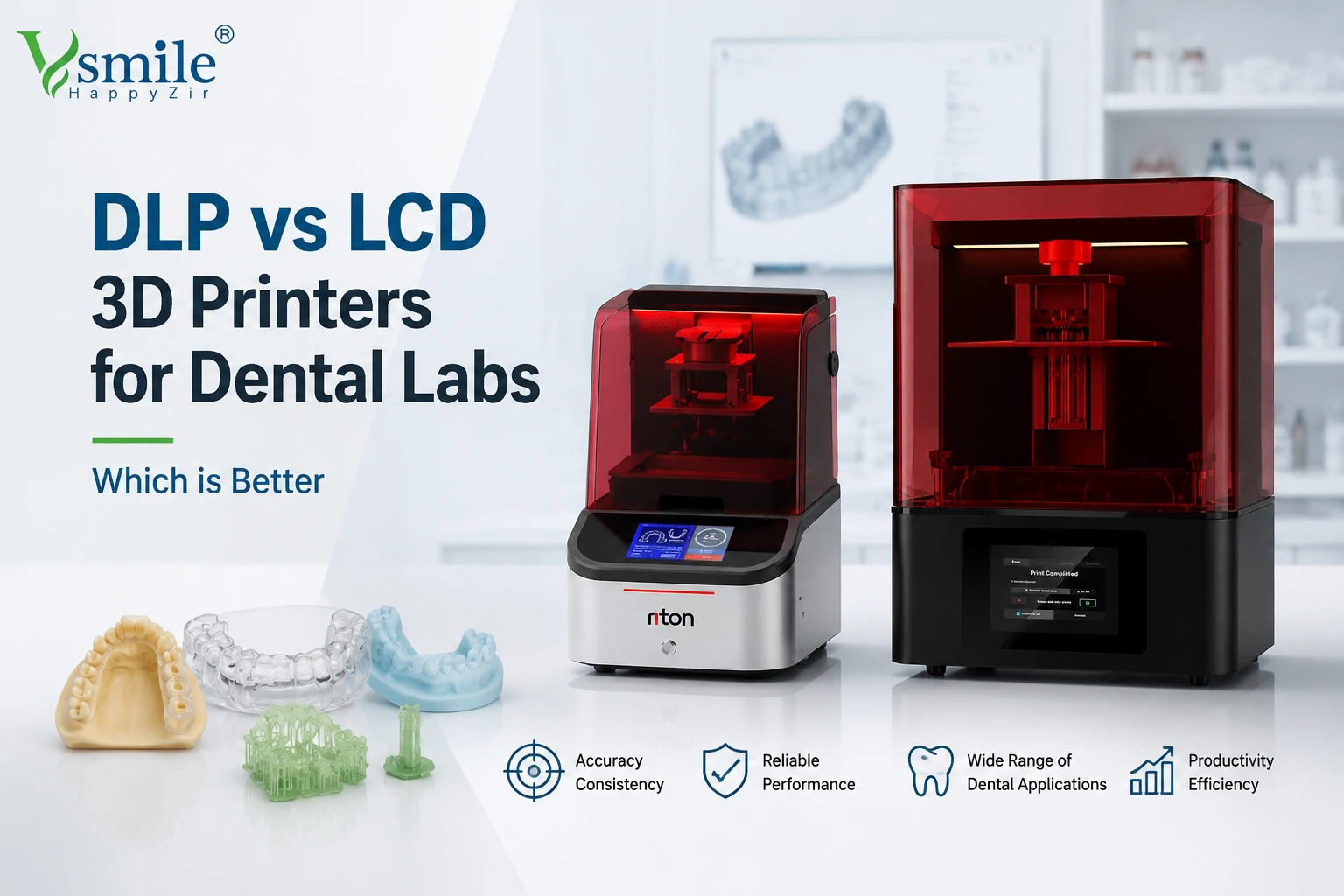
For dental labs, the DLP vs LCD 3D printer decision is not just a hardware comparison. It affects model output, surgical guide accuracy, splint fit, resin validation, staff training, and the cost of every accepted case.
DLP printers are often preferred for applications requiring highly consistent optical control and repeatable detail reproduction, while modern LCD printers can also achieve excellent accuracy when combined with proper calibration, resin validation, and workflow control. The better choice depends on the work your lab prints most often.
A dental lab should begin by listing the parts it prints every day: orthodontic models, working models, splints, surgical guides, custom trays, denture bases, gingiva masks, or temporary restorations. Each part creates a different risk profile.
If most jobs are models, the lab usually needs platform capacity and repeatable batch production. If the work includes surgical guides, splints, transparent parts, or implant-related applications, accuracy, light control, calibration, and resin consistency become more important than raw build area.
This is why the best choice is rarely ?DLP is always better? or ?LCD is always cheaper.? The right printer protects the cases that create the most value and the most risk in your lab.
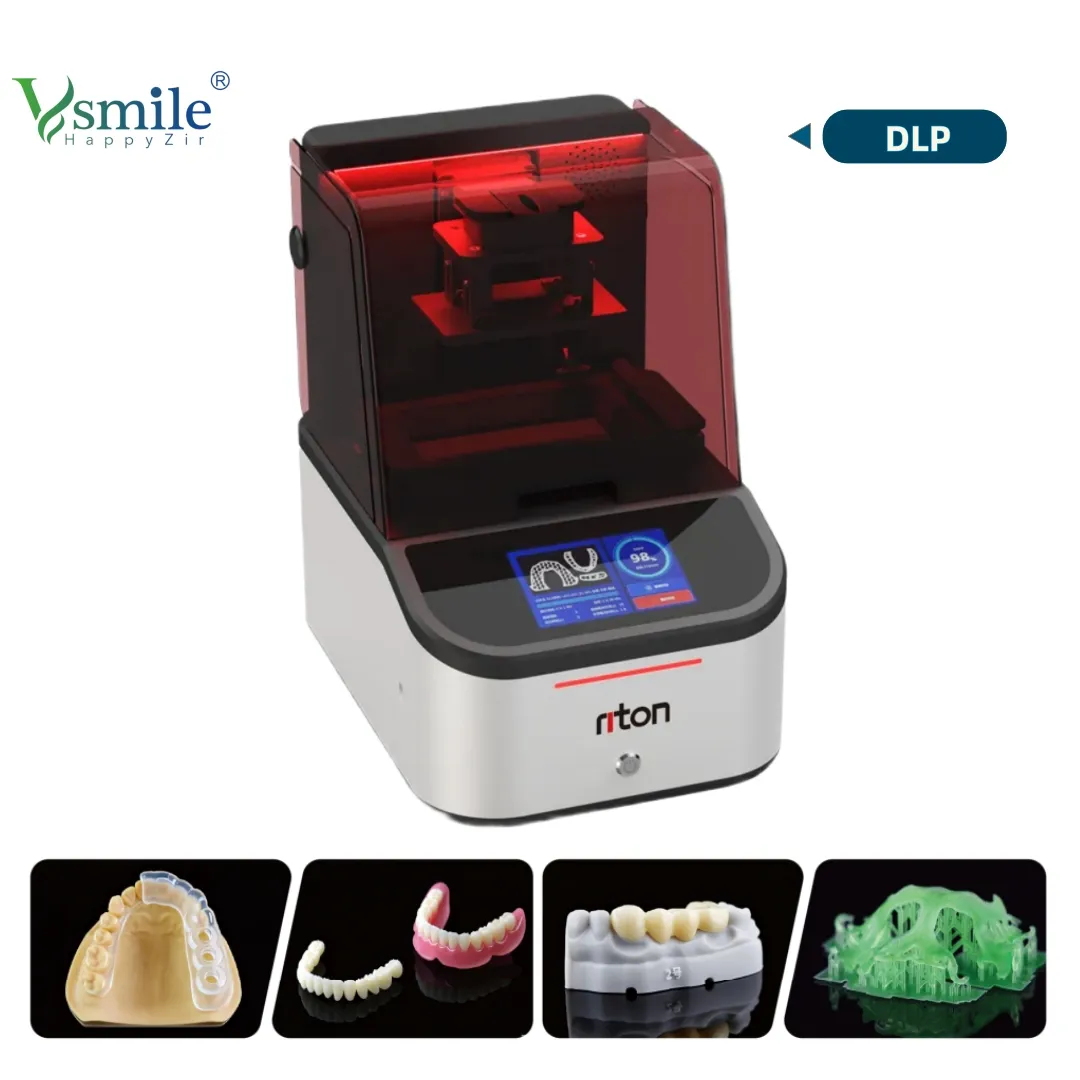
DLP printers cure each layer with a projected light image. In dental work, that can support strong detail reproduction, smooth surfaces, and stable curing when the optical system is well controlled. For labs that print surgical guides, splints, transparent applications, and high-detail parts, a precision-focused Dental DLP 3D Printer is usually the safer direction. DLP can be advantageous for some transparent applications because of its optical control, but final clarity depends heavily on resin formulation, curing parameters, and post-processing.
The Vsmile VRP D130 fits this type of workflow with a 385 nm DLP projection system, one-click light calibration, smart monitoring for temperature, humidity, resin level and pressure, automatic resin feeding, and a dual-platform/dual-vat design. For buyer-side evaluation, those features matter because they reduce manual adjustment and help keep output stable over time.
For applications where dimensional accuracy is critical, such as surgical guides and splints, printer stability, resin validation, calibration, and post-curing control are often more important than the printing technology alone.
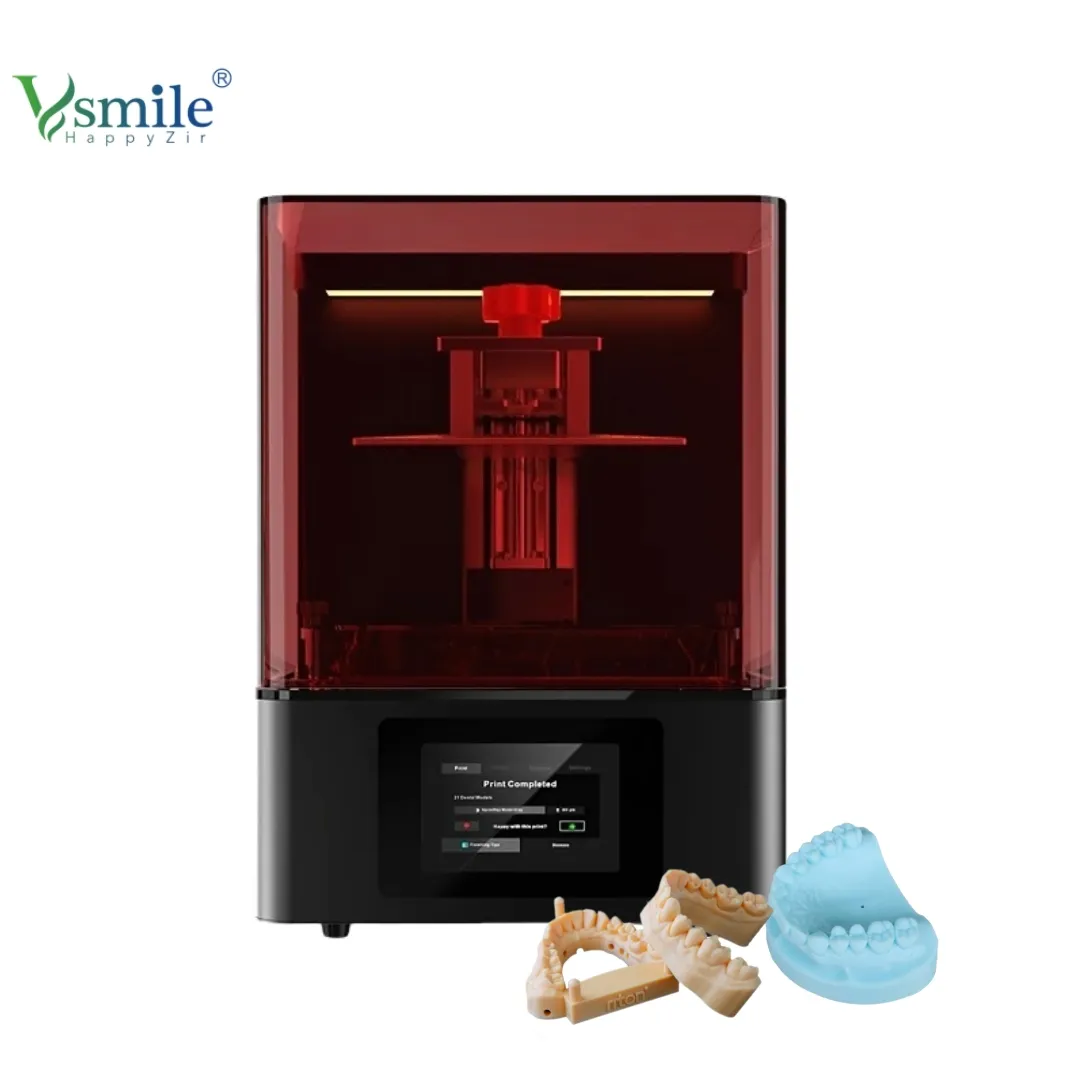
LCD printers cure resin through a masked LCD screen. Their main advantage for dental labs is efficient batch output. A professional Resin 3D LCD Printer can print multiple models in one job, helping the lab reduce handling time and increase daily production.
The Vsmile VRP L230 is built around this production logic: 8K LCD resolution, 30 μm XY resolution, a 228 x 128 x 150 mm build volume, a 385 nm COB plus Fresnel lens light system, and batch capacity for model-heavy workflows. For labs with many orthodontic or restorative models, these details can directly affect throughput and labor cost.
LCD is not simply a budget option. A well-built dental LCD printer can deliver accurate, repeatable results for models and many routine lab applications. The key is to verify light uniformity, Z-axis stability, resin parameters, and consistency across the full platform.
| Feature | DLP Technology (VPRD130) | LCD Technology (VPR L230) |
|---|---|---|
| Core Imaging System | Industrial light engine with direct projection; high stability. | LCD monochrome screen; sensitive to heat and UV exposure. |
| Light Source Life | 20,000 hours. | 2,000–4,000 hours (Screen is a consumable). |
| Molding Size | Smaller: 130×70×120mm. | Larger: 228×128×150mm. |
| Batch Capacity | ~2 full models per batch. | ~8 full models per batch. |
| Accuracy | Consistent 30μm precision with industrial stability. | High resolution (8K), but less stable over long periods. |
| Maintenance | Low maintenance; "Set-and-Forget" industrial durability. | Higher maintenance; screens are easily damaged by user error. |
| Intelligence | Auto-refilling, environment control, and force monitoring. | Simplified "Plug-and-Play" with basic leveling. |
| Best Used For | High-value clinical restorations: Surgical guides, splints, and bases. | Mass production of dental models for labs. |
DLP often has the edge when the lab needs the highest control over fine detail and curing consistency. In surgical guide and splint workflows, small dimensional errors can create remakes, chairside adjustment, or clinical frustration.
LCD accuracy depends on resolution, pixel behavior, light uniformity, Z-axis precision, and material settings. An 8K dental LCD printer can perform very well, but buyers should not evaluate it by resolution alone. Ask whether accuracy remains consistent across the whole build plate, not only in the center.
LCD printers can provide strong production efficiency for model-heavy workflows, especially when their build volume allows better nesting and batch utilization. A larger build area can reduce the number of print cycles, especially in orthodontic and restorative model production.
DLP can still support efficient production, especially when dual platforms, dual vats, and automatic resin feeding help material switching and unattended work. But for model-heavy labs, LCD usually gives the cleaner output-per-investment argument.
The printer decision is only half of the workflow. Dental model resin, surgical guide resin, splint resin, denture base resin, gingiva mask resin, and temporary crown and bridge resin each behave differently. A safer procurement process connects the printer with validated Dental 3D Printing Resins for the parts your lab produces.
For teams that compare both technologies, Dental 3D Printing Resin for LCD/DLP 3D Printer options help keep the discussion focused on complete workflow performance, not only machine price.
Ask suppliers which resin parameters are pre-installed, what post-curing process is recommended, and which applications have been tested. This is especially important for surgical guides, splints, denture applications, and any part that must meet clinical handling requirements.
A lower printer price does not always mean a lower production cost. Dental labs should compare cost per accepted part, including failed prints, recalibration time, resin waste, spare parts, screen or light-source life, operator training, and service response.
For DLP, look at calibration automation, light-engine life, vat workflow, and failure reduction in high-risk cases. For LCD, look at platform utilization, screen replacement, batch nesting efficiency, and output consistency over long production days.
Choose DLP if your lab prioritizes surgical guides, splints, transparent applications, implant workflows, or any case where precision risk is expensive. Choose LCD if your lab mainly needs high-volume model production, larger batch capacity, and efficient daily output.
Growing labs may benefit from both technologies: LCD for models and DLP for precision cases. A one-stop digital dentistry partner such as Vsmile HappyZir can help match printers, resins, support, and training around the full lab workflow instead of treating each machine as an isolated purchase.
Contact us for your specific quotations. Vsmile also provide training, spare parts, maintenance, and troubleshooting response. For labs standardizing a new workflow, Vsmile training resources and after-sales support can reduce the learning curve after installation.
Share your case mix, expected daily output, resin applications, and current digital workflow to compare printer options around real production needs.
DLP is often better for high-precision dental applications such as surgical guides, splints, transparent parts, and implant-related work. LCD is often better for efficient model production and larger batch output.
Yes. A professional dental LCD printer can be accurate enough for many models, orthodontic cases, and restorative workflows when light uniformity, Z-axis precision, resin parameters, and post-curing are controlled.
DLP (Digital Light Processing) technology, specifically the Vsmile D130, is the superior technology for producing surgical guides
LCD is often better for model-heavy labs because a larger build area can print more models in one job and reduce labor per batch.
DLP vs LCD is a workflow decision. DLP with a well-controlled workflow protects precision-sensitive cases.; LCD supports efficient batch production. The best dental lab printer is the one that matches your case mix, resin requirements, staff skill, and growth plan.
For deeper workflow reading, the Vsmile technical blog follows the same practical approach: start from the lab problem, compare the risk, then choose the equipment and material system that protects the final restoration.

Vsmile is pleased to announce its participation in the 3rd Algerian Dental Expo (ADEX 2026), taking place from November 11 to 14, 2026, at the Palais des Expositions (SAFEX) in Algiers, Algeria.
At this year's exhibition, Vsmile will join its local distribution partner, WHITE TRADER, at Pavillon A. Together, the teams will connect with dental professionals and showcase dental materials, CAD/CAM solutions and practical applications for modern dental laboratory workflows.

This bundle combines the powerful VSF300 fast sintering furnace with 4 pcs of 3D Prism multilayer zirconia blocks, delivering speed, capacity, and consistent esthetics in one package.

Passive fit failure is rarely caused by a single factor. Instead, it is the result of error stacking across the entire digital and manufacturing workflow.

Fracture and microcracks are among the most critical failure modes in All-on-X (AOX) zirconia restorations.

Whether you're crafting A1 or D4, FreeTone White Zirconia Disc gives you total shade control with just one SKU — streamlining inventory and increasing productivity.

Voices from Vsmile Global Partners — Stories of Trust, Growth, and Smiles We Create Together.

Long-span and full-arch restorations represent some of the most complex and failure-prone procedures in digital dentistry. Challenges include connector fractures, marginal misfits, sintering deformation, and low clinical longevity. Labs and clinics face a high rate of remakes, increased cost, and pressure to maintain quality under tight delivery deadlines.
2025.5.22

Vsmile offers a complete, validated digital workflow — from scanning to final zirconia bridge — that helps labs and clinics deliver life-changing smiles faster, with greater confidence and repeatable quality.


Tel: +86-731-85682958
Fax: +86-731-85682958
WhatsApp: +8615084896166/+8618569525651
Email: [email protected]
Address:
Room 1202-1203, Building A4,Huanchuang Corporate Park,No.2450, Yuelu West Avenue, Changsha Hi-tech Development District, Changsha, China.



















































 EN
 fr
 ru
 nl
 uk
 fil
 lo
 ko
 it
 es
 el
 pt
 de
 th
 be
 sq
 tr
 ar
 vi
 pl