Trusted by 6000+ Labs · ISO13485 Certified · Fast Delivery from 3 Factories


The right dental milling machine is decided by five questions, not by the longest spec sheet: which materials and restorations it must actually run, what its accuracy figure measures, whether it fits your CAD/CAM workflow, whether your lab can physically support it, and what ownership looks like after installation. Answer these before requesting quotes and most comparison mistakes disappear. Answer them after paying and they become expensive discoveries. This guide works through each question with its real trade-offs, then shows how three machines in one product family answer them differently.
Start from your case mix, not from axis counts. Materials decide milling mode first: zirconia, PMMA, PEEK, and wax mill dry, while glass ceramics and titanium need coolant, which means wet capability or a wet-and-dry machine. A lab that mills lithium disilicate veneers or titanium premilled abutments regularly is disqualified from a dry-only machine no matter how attractive its price. The Vsmile C512D dry milling machine covers exactly the dry list, milling zirconia, PMMA, PEEK, and wax, with published zirconia milling time of 20 minutes or less per disc.
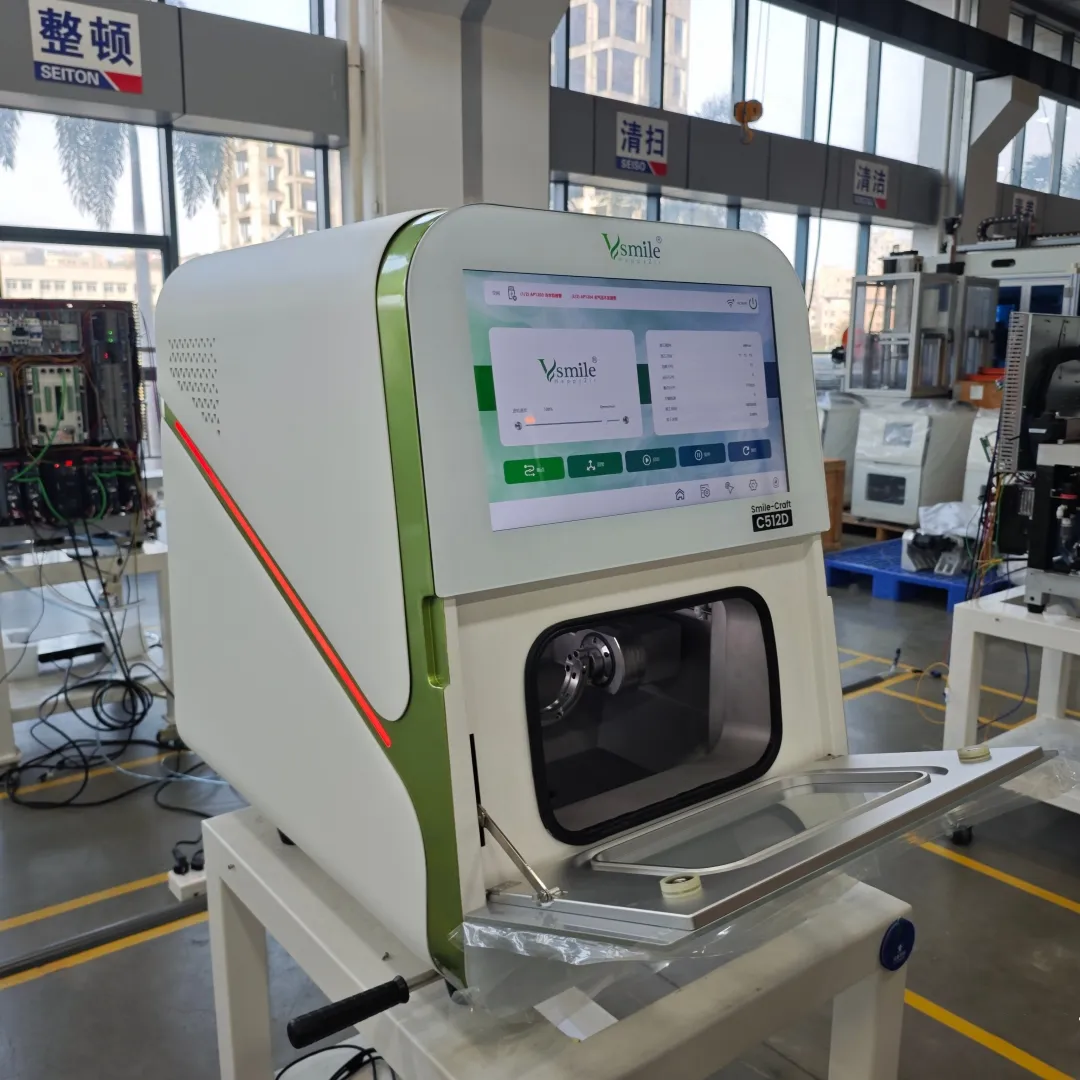
A dedicated dry machine is simpler: no coolant tank to fill, no cross-contamination risk, less daily cleaning. A wet-and-dry machine such as the C518DW 5-axis wet and dry milling machine handles zirconia in the morning and glass ceramics or titanium in the afternoon, which removes the need for a second machine later, but it adds coolant management, a water tank, and more chamber cleaning to every shift. If wet materials appear only a few times a year, the combined system may carry complexity you rarely use.
Restoration geometry matters too: implant bars and screw-retained bridges demand full 5-axis access, and rotary range differs by model, so list your most complex recurring case and check it against the machine's axis travel, holder design, and bur access rather than the "5-axis" label alone.
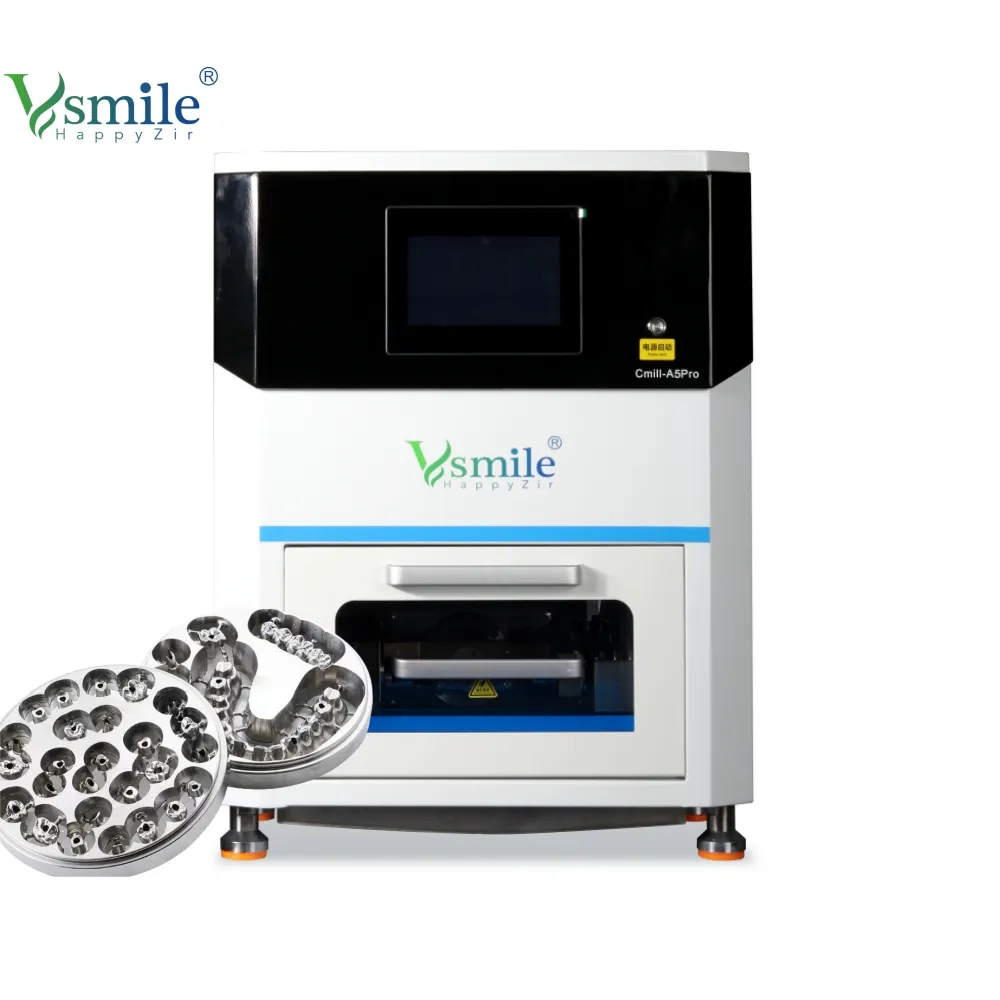
Published precision numbers are not directly comparable, because suppliers quote different metrics. Positioning accuracy describes how precisely the machine reaches a coordinate; repetition accuracy describes how consistently it returns to it across runs. The Vsmile A5 Pro milling machine is listed with a positioning accuracy of 0.003 mm or better, and the C518DW states a repetition accuracy of 0.005 mm.
There is also a difference between specified accuracy and delivered fit. Accuracy holds only while the machine is calibrated, so ask whether calibration is automatic, how often it runs, and what the operator must do after a tool change or an abnormal stop. The decisive check costs little: before paying, ask the supplier to mill one of your own design files in your usual material, then measure the marginal fit the way your technicians normally would. A demo crown milled from the supplier's showroom file tells you far less than your own tight interproximal case.
An open machine that accepts standard STL files protects you from being locked into one supplier's scanner, software, or materials. In practice the binding constraint is CAM: the machine must have a validated postprocessor for the software your technicians already run. The three machines above support industry-standard CAM packages including MillBox, Hyperdent, and WorkNC, but support is only useful if it covers your version and your nesting strategy. Ask which CAM versions are validated, who supplies the license and future updates, whether a workstation is included, and who owns the settings if the machine is reinstalled. A screenshot of software running in a demo does not establish that a license is part of your order. You can browse the full Vsmile equipment and materials catalog to see how a milling machine pairs with scanners, sintering furnaces, and burs before you commit to a configuration.
Compact machines still impose site requirements, and these are the questions buyers forget until installation week. Compressed air is the most common constraint: the C512D requires 6 bar at 95 L/min, and the C518DW requires at least 0.5 MPa at 90 L/min, so a lab without a sufficient compressor must budget for one. All three machines run on 220V power. Footprints are similar, roughly 525 x 700 x 784 mm for the C512D and C518DW, but weights differ meaningfully: the A5 Pro is about 104 kg while the C518DW is about 150 kg, so the bench or floor point must take the load plus vibration. Wet-and-dry machines add a coolant water tank, about 10 L on the C518DW, which needs filling, draining, and periodic cleaning. Ask the supplier for a written installation sheet listing power, air, water, and clearance requirements, and walk your lab with it before you sign anything.
Purchase price is only the entry ticket. Tool magazine capacity shapes how much operator intervention a job needs: the C512D carries 10 tools, and the C518DW carries 18 with tool life monitoring that flags wear before it ruins a case. Confirm the tool count for any model in writing, because feature lists and specification tables for the same machine can carry different figures. Consumables continue after the invoice: burs wear and need replacement on a schedule, so ask for bur references, expected life per material, and the cost of a starter set.
Ask specifically what the quote includes, because these items are rarely published: installation and commissioning, operator training, warranty scope and duration, spare parts lead times, and remote support hours. Routine care is also part of the deal. A structured schedule, daily chamber and gas-liquid separator checks, weekly chuck cleaning, monthly calibration against specified tolerances, keeps precision from drifting; the C512D daily, weekly, and monthly maintenance guide shows what that routine looks like for one machine in practice. A supplier who can show you the maintenance routine, the training plan, and the spare parts path before purchase is more credible than one who promises support in general terms.
The comparison matrix at the end of this guide applies the five questions to three machines in the same product family. It shows why "which machine is best" has no single answer: the right machine is the one whose columns match your answers to the five questions.
A quote is only as comparable as the information behind it. Before contacting a supplier, write down your case mix by percentage, the materials you mill weekly, your CAD and CAM software with versions, your current machine if you have one, and your expected weekly unit volume. Vsmile's inquiry form asks for exactly these details, including your current CAD/CAM machine and estimated order quantity, which means a complete submission returns a configuration review instead of a generic price list.
A dry-focused machine in the C512D class fits a zirconia-centered workflow, because zirconia, PMMA, PEEK, and wax all mill dry and the workflow stays free of coolant management. Confirm your weekly zirconia volume and turnaround targets against the machine's milling time and tool capacity before deciding, and ask whether any upcoming case types would require wet capability later.
Yes, if it supports both dry and wet milling, which is the C518DW and A5 Pro class of machine. Zirconia runs dry, titanium and premilled abutments run wet, and holders matter as much as the spindle: confirm how many premilled abutment holders and glass ceramic holders are included and how long a mode changeover takes between a dry zirconia job and a wet titanium job.
Include your case mix, weekly material list, CAD and CAM software with versions, current machine brand and model, expected unit volume, and any space, power, or compressor constraints at your site. Suppliers who receive this brief can quote the right configuration, the correct tooling, and the realistic installation requirements, and you can compare their answers question by question instead of comparing prices for different machines.
Ask which metric the figure describes, positioning or repetition, and how it was measured. Then request a test mill of one of your own design files in your regular material and measure the marginal fit with your usual method. Check how calibration is performed, whether it is automatic, and what the operator must do after a tool change or an unexpected stop.
Plan a daily routine of chamber cleaning, gas-liquid separator checks, and bur condition checks, a weekly chuck inspection, and monthly calibration against the tolerances in the manual. Ask the supplier at quotation stage for the maintenance schedule, the training included for your technicians, and the response path when something fails, so ownership costs are known before the machine arrives.
| Question | C512D | C518DW | A5 Pro |
|---|---|---|---|
| Materials and mode | Dry only: zirconia, PMMA, PEEK, wax | Dry and wet: adds glass ceramics, composite, titanium | Dry and wet: adds glass ceramics, titanium discs, premilled abutments |
| Spindle | 1.8 kW fluid-cooled, 60,000 rpm | 2.5 kW water-cooled, 60,000 rpm | 1.8 kW, 60,000 rpm, wet and dry |
| Tool magazine | 10 tools | 18 tools with life monitoring | Automatic changer; confirm count in writing |
| Stated precision | Ask which metric applies | Repetition 0.005 mm | Positioning 0.003 mm or better |
| CAM support | MillBox, WorkNC | MillBox, Hyperdent, WorkNC | Open STL system; confirm postprocessor |
| Site load | About 130 kg, 6 bar and 95 L/min air | About 150 kg, 0.5 MPa and 90 L/min air, 10 L tank | About 104 kg, compact benchtop unit |
| Best fit | Zirconia-focused dry workflow | Mixed materials, higher volume, implant work | Space-conscious labs adding titanium and ceramic work |
There is no single best milling machine, only the machine whose answers to the five questions match your own. Define the material list and restoration types, ask which accuracy metric is quoted and verify it on a test mill of your own file, confirm CAM postprocessors and licences, check that your site can carry the power, air, water, and weight, and get installation, training, warranty, consumables, and spare-part terms in writing. The comparison matrix shows how three machines in one family make different trade-offs; use it as a checklist, not a ranking. Send your case mix, weekly volumes, CAD/CAM versions, and site constraints through the inquiry form to get a configuration review rather than a generic price list.

Vsmile is pleased to announce its participation in the 3rd Algerian Dental Expo (ADEX 2026), taking place from November 11 to 14, 2026, at the Palais des Expositions (SAFEX) in Algiers, Algeria.
At this year's exhibition, Vsmile will join its local distribution partner, WHITE TRADER, at Pavillon A. Together, the teams will connect with dental professionals and showcase dental materials, CAD/CAM solutions and practical applications for modern dental laboratory workflows.

This bundle combines the powerful VSF300 fast sintering furnace with 4 pcs of 3D Prism multilayer zirconia blocks, delivering speed, capacity, and consistent esthetics in one package.

Passive fit failure is rarely caused by a single factor. Instead, it is the result of error stacking across the entire digital and manufacturing workflow.

Fracture and microcracks are among the most critical failure modes in All-on-X (AOX) zirconia restorations.

Whether you're crafting A1 or D4, FreeTone White Zirconia Disc gives you total shade control with just one SKU — streamlining inventory and increasing productivity.

Voices from Vsmile Global Partners — Stories of Trust, Growth, and Smiles We Create Together.

Long-span and full-arch restorations represent some of the most complex and failure-prone procedures in digital dentistry. Challenges include connector fractures, marginal misfits, sintering deformation, and low clinical longevity. Labs and clinics face a high rate of remakes, increased cost, and pressure to maintain quality under tight delivery deadlines.
2025.5.22

Vsmile offers a complete, validated digital workflow — from scanning to final zirconia bridge — that helps labs and clinics deliver life-changing smiles faster, with greater confidence and repeatable quality.


Tel: +86-731-85682958
Fax: +86-731-85682958
WhatsApp: +8615084896166/+8618569525651
Email: [email protected]
Address:
Room 1202-1203, Building A4,Huanchuang Corporate Park,No.2450, Yuelu West Avenue, Changsha Hi-tech Development District, Changsha, China.



















































 EN
 fr
 ru
 nl
 uk
 fil
 lo
 ko
 it
 es
 el
 pt
 de
 th
 be
 sq
 tr
 ar
 vi
 pl