Trusted by 6000+ Labs · ISO13485 Certified · Fast Delivery from 3 Factories


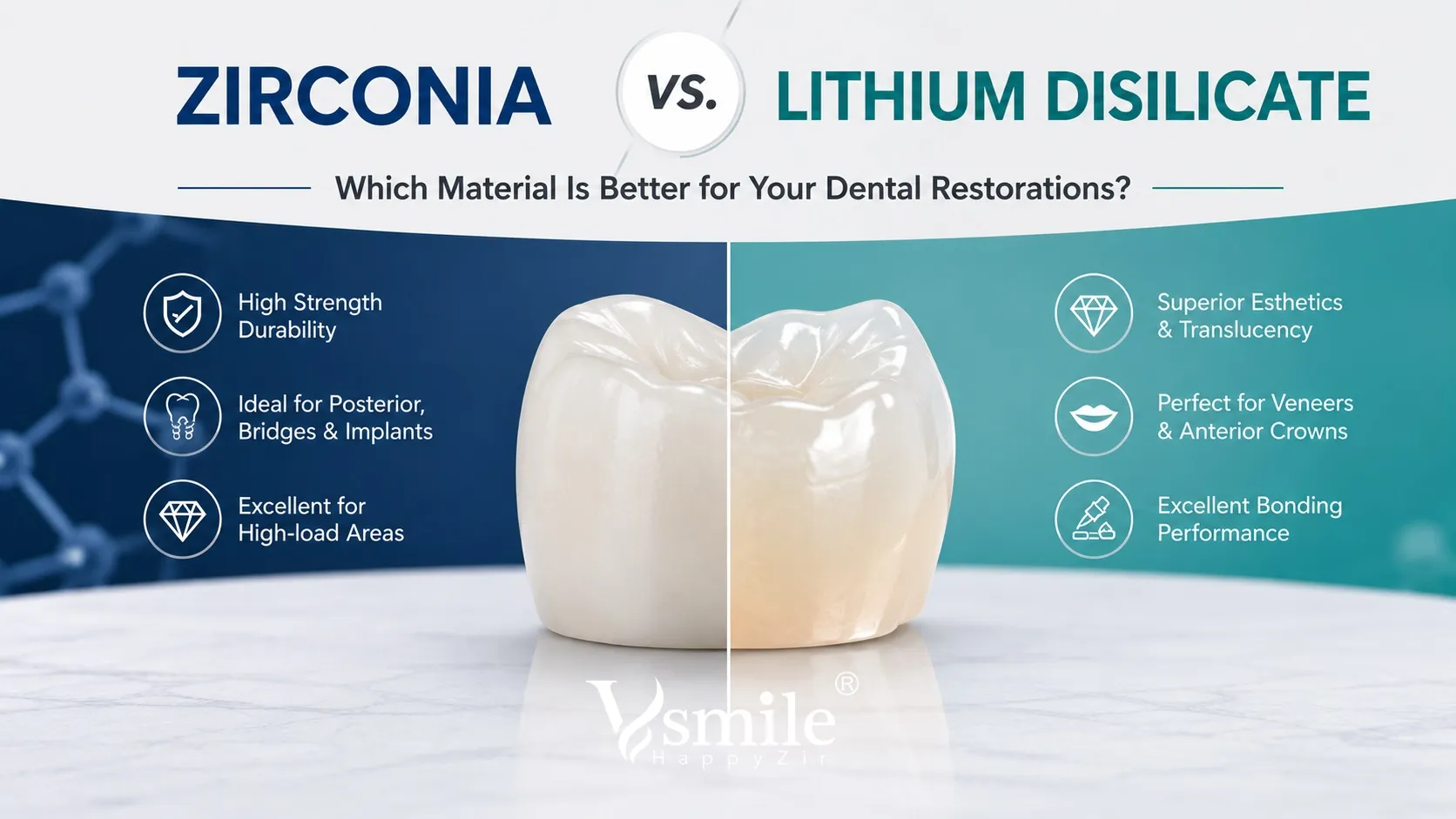
As digital dentistry continues to evolve, zirconia and lithium disilicate have become the two most widely used ceramic materials for fixed restorations. Whether producing single crowns, veneers, implant restorations, or full-arch prostheses, dental laboratories and clinicians frequently face the same question:
Should this case be made from zirconia or lithium disilicate?
The answer depends on several factors, including strength requirements, esthetic expectations, preparation design, occlusal conditions, and long-term clinical performance.
This article compares zirconia and lithium disilicate based on scientific evidence, clinical indications, and CAD/CAM manufacturing considerations to help dental professionals choose the most appropriate material for each case.
Zirconia (zirconium dioxide, ZrO₂) is a polycrystalline ceramic known for its exceptional mechanical strength and fracture resistance.
Modern dental zirconia has evolved significantly from the opaque first-generation materials introduced more than two decades ago. Today's multilayer zirconia offers improved translucency while maintaining excellent strength.
Common zirconia categories include:
3Y-TZP (high strength)
4Y zirconia (balanced strength and esthetics)
5Y zirconia (high translucency)
Multilayer gradient zirconia
Full-arch zirconia designed for All-on-X restorations
Zirconia restorations are typically fabricated through CAD/CAM milling and require high-temperature sintering before delivery.
Lithium disilicate is a glass-ceramic material widely recognized for its natural translucency and esthetic appearance.
The material is commonly associated with IPS e.max restorations and is often selected when achieving a highly lifelike result is the primary goal.
Lithium disilicate can be:
Pressed
Milled via CAD/CAM
Characterized through staining and glazing
Because of its glass-ceramic structure, lithium disilicate can be etched and adhesively bonded, providing excellent retention and esthetic integration.
| Property | Zirconia | Lithium Disilicate |
|---|---|---|
| Flexural Strength | 800–1200+ MPa | 360–500 MPa |
| Fracture Resistance | Excellent | Good |
| Translucency | Moderate to High (depending on generation) | Excellent |
| Esthetics | Very good | Outstanding |
| Bonding Capability | Requires special primers (MDP) | Can be etched and bonded |
| Posterior Crowns | Excellent | Suitable with proper case selection |
| Veneers | Limited indications | Gold standard |
| Bridges | Recommended | Limited indications |
| Full-Arch Restorations | Excellent | Not recommended |
| Bruxism Cases | Preferred | Higher fracture risk |
Studies consistently show zirconia exhibits significantly higher flexural strength and fracture resistance than lithium disilicate. Systematic reviews comparing translucent zirconia and lithium disilicate confirm zirconia's mechanical superiority, especially in high-load situations.
Modern zirconia typically demonstrates flexural strength between 800 MPa and 1,200 MPa or higher, depending on the formulation. This makes it particularly suitable for:
Posterior crowns
Implant-supported restorations
Long-span bridges
Full-arch prostheses
Patients with bruxism
Its transformation toughening mechanism helps resist crack propagation, contributing to excellent long-term durability.
Lithium disilicate generally offers flexural strength around 360–500 MPa.
While significantly stronger than traditional feldspathic porcelain, it remains less resistant to heavy occlusal forces compared with zirconia.
For this reason, clinicians often reserve lithium disilicate for:
Veneers
Anterior crowns
Premolar crowns
Inlays and onlays
Highly esthetic cases
When esthetics are the primary concern, lithium disilicate remains one of the benchmark materials.
Its glass-ceramic structure allows light transmission similar to natural enamel, producing highly lifelike restorations.
Advantages include:
Superior translucency
Natural fluorescence
Excellent shade matching
Ideal for smile-zone restorations
Yes.
Recent generations of 4Y and 5Y zirconia have significantly improved optical properties. Systematic reviews show that modern translucent zirconia materials provide much better esthetics than earlier generations, making them suitable for many anterior restorations.
However, lithium disilicate still generally offers the most enamel-like appearance in highly demanding cosmetic cases.
✔ Posterior crowns are required
✔ The patient has bruxism
✔ Implant-supported restorations are planned
✔ Multi-unit bridges are needed
✔ Full-arch restorations are fabricated
✔ Maximum durability is the priority
✔ Veneers are indicated
✔ Single anterior crowns are required
✔ Maximum translucency is desired
✔ Conservative tooth preparation is possible
✔ Adhesive bonding is preferred
✔ The patient prioritizes esthetics over extreme strength
A systematic review involving more than 2,400 zirconia and lithium disilicate crowns found that both materials demonstrate high survival rates when properly selected and fabricated. Clinical complications and overall longevity were broadly comparable.
Published long-term data show:
Lithium disilicate single crowns often achieve survival rates above 95% after 5–10 years.
Monolithic zirconia crowns frequently demonstrate survival rates around 97–98% at five years.
Zirconia generally performs better in bridge and full-arch applications due to its superior mechanical properties.
The most important takeaway is that case selection matters more than material marketing claims.
For dental laboratories operating CAD/CAM workflows, material selection also impacts manufacturing efficiency.
Advantages:
High milling efficiency
Suitable for large restorations
Consistent digital workflow
Excellent strength after sintering
Challenges:
Requires sintering
Shrinkage compensation must be accurate
Coloring and characterization require experience
Advantages:
Excellent esthetic outcomes
Predictable shade reproduction
Easier characterization
Challenges:
More sensitive to thickness requirements
Less suitable for high-stress restorations
Limited bridge indications
For modern digital dental laboratories, zirconia has become the dominant restorative material due to its versatility across a wide range of indications.
Modern dental laboratories rarely rely on a single restorative material. Instead, successful labs select materials according to each clinical indication, balancing esthetics, strength, efficiency, and cost.
To support diverse restoration needs, Vsmile offers a complete range of CAD/CAM dental materials, including:
Suitable for:
Vsmile also provides high-quality lithium disilicate glass ceramic blocks designed for highly esthetic restorations.
Benefits include:
Suitable for:
In addition to restorative materials, Vsmile offers:
This allows dental laboratories and milling centers to establish a fully integrated digital workflow from scanning to final restoration delivery.
Zirconia is significantly stronger than lithium disilicate. Modern zirconia materials typically exhibit flexural strengths ranging from 800 MPa to over 1,200 MPa, while lithium disilicate generally ranges between 360 MPa and 500 MPa.
Lithium disilicate generally provides higher translucency and more enamel-like esthetics, making it a preferred choice for highly visible anterior restorations.
Yes. Due to its high fracture resistance and durability, zirconia is often recommended for molars and posterior restorations that must withstand greater chewing forces.
Monolithic zirconia is currently one of the most commonly used materials for All-on-X restorations because it combines high strength, wear resistance, and long-term durability.
Yes. Advances in multilayer 4Y and 5Y zirconia have significantly improved translucency and shade gradients. Many anterior crowns are now successfully fabricated using highly translucent zirconia.
The decision depends on the tooth location, esthetic expectations, occlusal forces, and preparation design. Anterior crowns often benefit from lithium disilicate, while posterior crowns are commonly fabricated from zirconia.

Vsmile is pleased to announce its participation in the 3rd Algerian Dental Expo (ADEX 2026), taking place from November 11 to 14, 2026, at the Palais des Expositions (SAFEX) in Algiers, Algeria.
At this year's exhibition, Vsmile will join its local distribution partner, WHITE TRADER, at Pavillon A. Together, the teams will connect with dental professionals and showcase dental materials, CAD/CAM solutions and practical applications for modern dental laboratory workflows.

This bundle combines the powerful VSF300 fast sintering furnace with 4 pcs of 3D Prism multilayer zirconia blocks, delivering speed, capacity, and consistent esthetics in one package.

Passive fit failure is rarely caused by a single factor. Instead, it is the result of error stacking across the entire digital and manufacturing workflow.

Fracture and microcracks are among the most critical failure modes in All-on-X (AOX) zirconia restorations.

Whether you're crafting A1 or D4, FreeTone White Zirconia Disc gives you total shade control with just one SKU — streamlining inventory and increasing productivity.

Voices from Vsmile Global Partners — Stories of Trust, Growth, and Smiles We Create Together.

Long-span and full-arch restorations represent some of the most complex and failure-prone procedures in digital dentistry. Challenges include connector fractures, marginal misfits, sintering deformation, and low clinical longevity. Labs and clinics face a high rate of remakes, increased cost, and pressure to maintain quality under tight delivery deadlines.
2025.5.22

Vsmile offers a complete, validated digital workflow — from scanning to final zirconia bridge — that helps labs and clinics deliver life-changing smiles faster, with greater confidence and repeatable quality.


Tel: +86-731-85682958
Fax: +86-731-85682958
WhatsApp: +8615084896166/+8618569525651
Email: [email protected]
Address:
Room 1202-1203, Building A4,Huanchuang Corporate Park,No.2450, Yuelu West Avenue, Changsha Hi-tech Development District, Changsha, China.



















































 EN
 fr
 ru
 nl
 uk
 fil
 lo
 ko
 it
 es
 el
 pt
 de
 th
 be
 sq
 tr
 ar
 vi
 pl