Trusted by 6000+ Labs · ISO13485 Certified · Fast Delivery from 3 Factories


Even as digital workflows and high-strength materials like zirconia and lithium disilicate have become commonplace, PMMA (polymethyl methacrylate) continues to play a critical role in dental laboratories across the United States. Its combination of ease of use, flexibility, and efficiency makes it an enduring choice for provisional restorations, trial fittings, and workflow testing.
For many small and mid-sized labs, PMMA offers a way to experiment with digital workflows without committing high-cost materials, providing both practical and financial benefits.
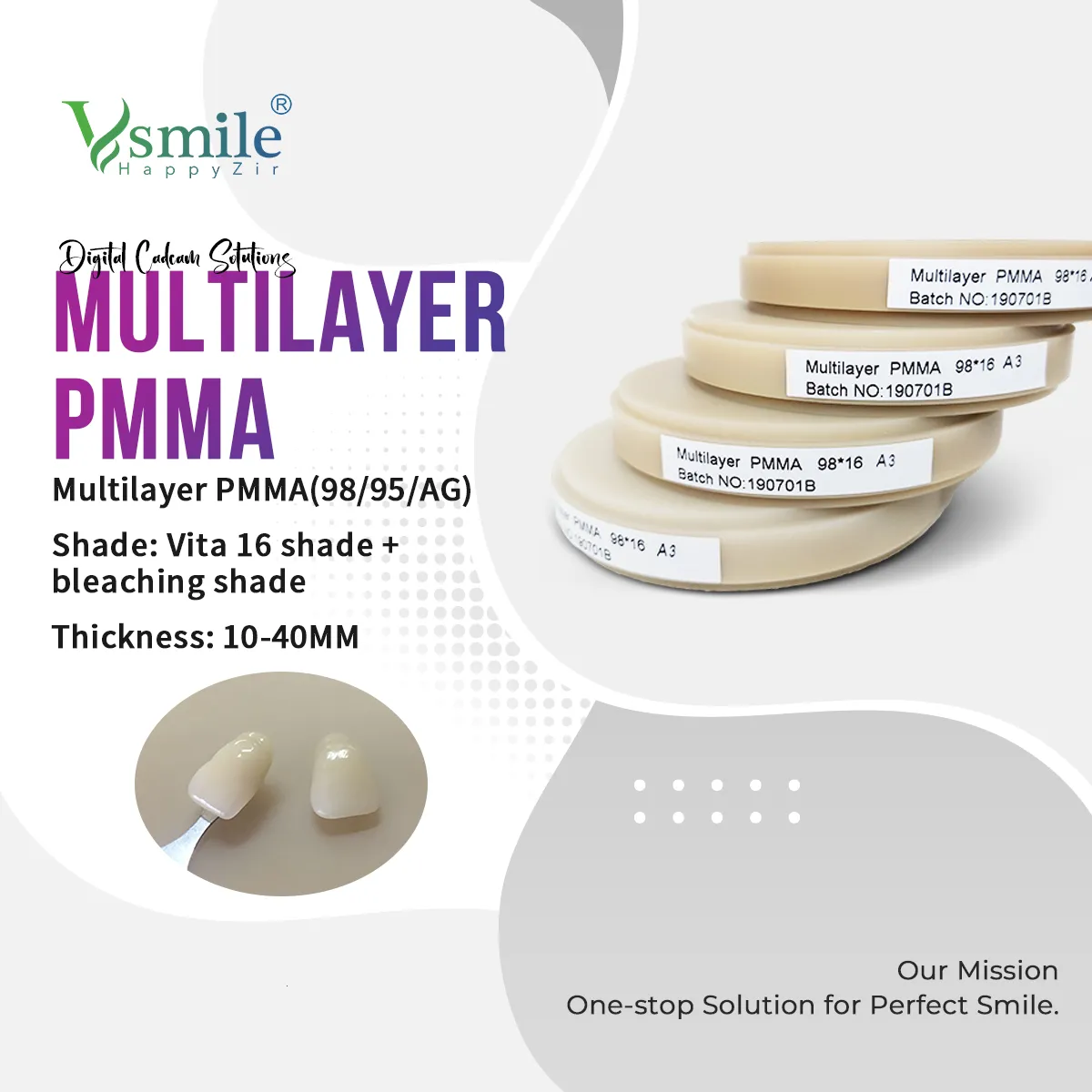
Provisional Crowns and Bridges
PMMA is widely used for temporary restorations, allowing clinicians to evaluate fit, occlusion, and aesthetics before final restoration. Technicians can quickly fabricate PMMA crowns or bridges, often refining the design iteratively based on feedback from the dental office. This reduces the likelihood of adjustments on the final restoration.
Trial Fittings and Digital Workflow Validation
Small labs frequently use PMMA to test digital designs before milling final restorations. For example, a lab might print or mill a PMMA prototype to verify occlusal contacts, margin alignment, and patient-specific adjustments. This step helps identify potential errors in the CAD/CAM workflow before costly materials are processed.
Cost-Effective Material for Training and Calibration
New technicians or interns can practice milling, finishing, and handling techniques on PMMA. Using PMMA minimizes material waste while allowing staff to gain hands-on experience.
PMMA is appreciated for several practical properties that make it a staple in dental labs:
Ease of milling: PMMA can be processed on a range of desktop or lab milling machines, allowing for rapid iteration of designs.
Surface polishability: Smooth surfaces can be achieved with minimal effort, making temporary restorations comfortable for patients.
Adjustability: PMMA can be trimmed, relined, or modified easily without compromising structural integrity, unlike more brittle materials.
However, technicians must remain aware of PMMA’s limitations:
Strength and wear resistance: PMMA is suitable for temporary use; it is not intended for long-term or high-load restorations.
Heat sensitivity: When adjusting or polishing, excessive heat can cause distortion or surface irregularities.
In modern U.S. dental labs, PMMA fits naturally into digital workflows. For labs using CAD/CAM systems:
PMMA allows rapid milling of provisional designs for fit verification and aesthetic review.
Errors in scanning or design can be detected at the PMMA stage, preventing costly mistakes with zirconia or lithium disilicate.
Labs can maintain a streamlined production schedule, as PMMA restorations typically require less post-processing than more complex materials.
This stepwise approach ensures that high-cost materials are used efficiently, and that the workflow remains predictable.
Technicians in small to mid-sized laboratories across the U.S. report that:
Incorporating PMMA for provisional or trial restorations reduces rework on final cases.
Using PMMA to test occlusion and margins allows adjustments before expensive materials are used, improving workflow reliability.
PMMA’s flexibility supports staff training, workflow testing, and communication with dental offices, providing practical benefits beyond material cost.
These insights underscore that PMMA remains essential not as a replacement, but as a complementary material within modern dental workflows.
While high-strength ceramics and advanced milling technologies dominate permanent restorations, PMMA continues to hold a vital role in U.S. dental labs. Its versatility, ease of handling, and compatibility with digital workflows make it indispensable for provisional restorations, trial fittings, and technician training.
For laboratories seeking to maximize efficiency, reduce errors, and manage costs, PMMA is not obsolete—it is a practical tool that supports modern restorative workflows and ensures smoother production from design to final delivery.

Vsmile is pleased to announce its participation in the 3rd Algerian Dental Expo (ADEX 2026), taking place from November 11 to 14, 2026, at the Palais des Expositions (SAFEX) in Algiers, Algeria.
At this year's exhibition, Vsmile will join its local distribution partner, WHITE TRADER, at Pavillon A. Together, the teams will connect with dental professionals and showcase dental materials, CAD/CAM solutions and practical applications for modern dental laboratory workflows.

This bundle combines the powerful VSF300 fast sintering furnace with 4 pcs of 3D Prism multilayer zirconia blocks, delivering speed, capacity, and consistent esthetics in one package.

Passive fit failure is rarely caused by a single factor. Instead, it is the result of error stacking across the entire digital and manufacturing workflow.

Fracture and microcracks are among the most critical failure modes in All-on-X (AOX) zirconia restorations.

Whether you're crafting A1 or D4, FreeTone White Zirconia Disc gives you total shade control with just one SKU — streamlining inventory and increasing productivity.

Voices from Vsmile Global Partners — Stories of Trust, Growth, and Smiles We Create Together.

Long-span and full-arch restorations represent some of the most complex and failure-prone procedures in digital dentistry. Challenges include connector fractures, marginal misfits, sintering deformation, and low clinical longevity. Labs and clinics face a high rate of remakes, increased cost, and pressure to maintain quality under tight delivery deadlines.
2025.5.22

Vsmile offers a complete, validated digital workflow — from scanning to final zirconia bridge — that helps labs and clinics deliver life-changing smiles faster, with greater confidence and repeatable quality.


Tel: +86-731-85682958
Fax: +86-731-85682958
WhatsApp: +8615084896166/+8618569525651
Email: [email protected]
Address:
Room 1202-1203, Building A4,Huanchuang Corporate Park,No.2450, Yuelu West Avenue, Changsha Hi-tech Development District, Changsha, China.



















































 EN
 fr
 ru
 nl
 uk
 fil
 lo
 ko
 it
 es
 el
 pt
 de
 th
 be
 sq
 tr
 ar
 vi
 pl