Trusted by 6000+ Labs · ISO13485 Certified · Fast Delivery from 3 Factories


When discussing veneer failures, many people immediately focus on the ceramic material, bonding system, or laboratory fabrication process.
However, the success of a veneer restoration often begins much earlier—during tooth preparation.
One of the most critical yet frequently underestimated factors is the finish line design.
A poorly positioned finish line can create problems that affect:
In other words:
A veneer is not only about how much tooth structure is removed. It is about where and how the preparation ends.
The finish line is the precise boundary where the prepared tooth structure transitions into the unprepared tooth surface.
For porcelain veneers and other ceramic restorations, this area determines how the restoration margin will be designed and how much ceramic material is available at the edge.
A properly designed finish line allows the dental laboratory to create:
A poorly designed finish line can force the technician to compensate during CAD design, often resulting in excessive contour or insufficient material thickness.
Modern ceramic veneers require carefully controlled thickness to achieve both strength and esthetics.
If the finish line is positioned too close to the contact area, the laboratory may not have enough space to design the restoration properly.
This can lead to:
Adequate preparation space gives the technician better control over ceramic morphology and optical properties.
The emergence profile describes how the restoration transitions from the tooth surface into the surrounding soft tissue.
A correct finish line allows the restoration to follow natural anatomy.
An incorrectly positioned margin may create:
For highly esthetic anterior restorations, proper emergence profile design is essential.
The veneer margin is one of the most important areas influencing long-term performance.
An accurate finish line helps achieve:
Poor marginal design may increase the risk of:
While preparation design depends on clinical conditions, material selection, and dentist preference, a commonly recommended approach includes:
| Area | Recommended Space Consideration |
|---|---|
| Lingual area | Approximately 2 mm lingual to contact |
| Proximal area | Approximately 1 mm clearance |
| Facial preparation | Controlled reduction based on ceramic requirements |
These dimensions help provide sufficient space for the ceramic restoration while maintaining conservative tooth preparation.
Important: Final preparation should always be adapted according to the selected ceramic system, occlusion, tooth condition, and clinical requirements.
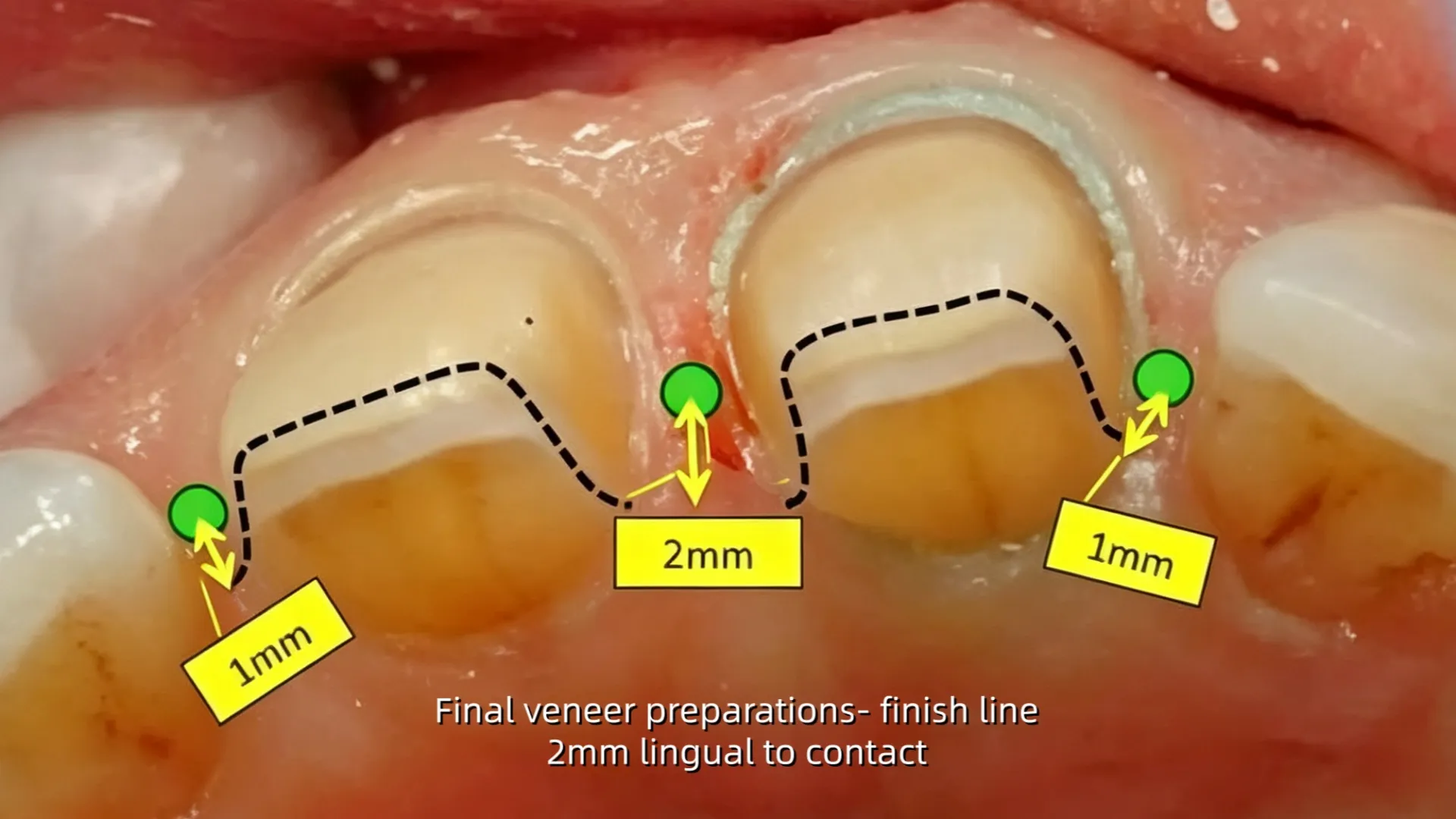
A finish line positioned too close to the contact area can create several challenges.
When insufficient space exists, the laboratory may need to increase restoration thickness externally.
The result may be:
Improper contour and limited access may make cementation more challenging.
Potential consequences include:
Insufficient ceramic thickness or unsupported ceramic areas may reduce mechanical reliability.
Long-term risks may include:
A successful veneer restoration is not created by the dentist or laboratory alone.
It requires communication between:
Responsible for:
Responsible for:
A precise preparation provides the laboratory with the information needed to create predictable results.
Modern digital workflows have improved communication and precision between clinics and laboratories.
A typical digital veneer workflow includes:
↓
↓
↓
↓
↓
Digital tools allow technicians and clinicians to evaluate:
before final fabrication.
The finish line design must also match the ceramic material.
Common veneer materials include:
Advantages:
Commonly used for:
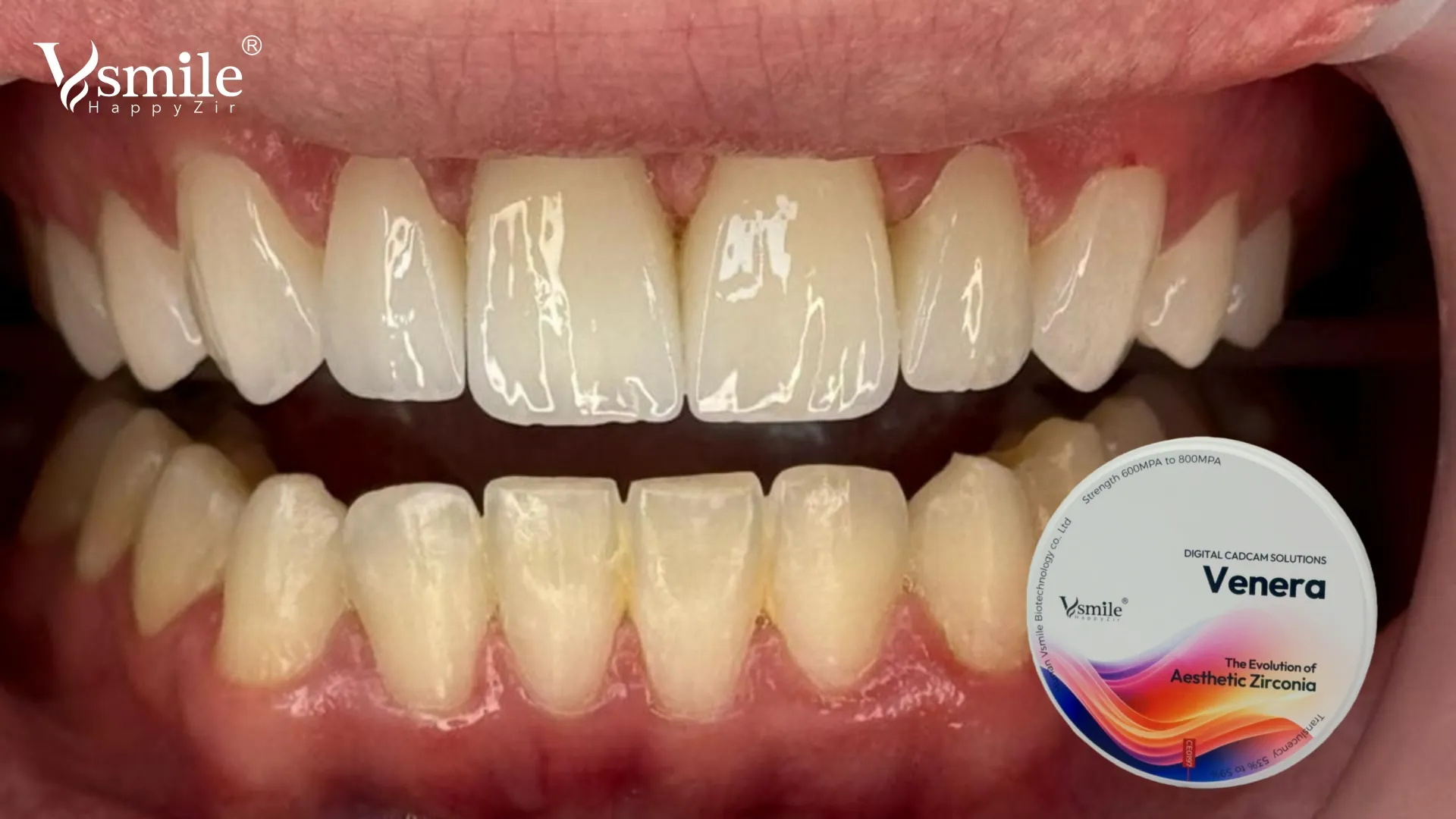
Modern multilayer zirconia provides:
Often selected for:
Material selection should always consider:
The preparation should be designed backward from the final restoration.
Insufficient space near contacts can compromise contour and esthetics.
Different materials require different preparation strategies.
Without preparation details, photos, scans, or shade information, achieving predictable results becomes more difficult.
Long-lasting veneers are not created only by choosing premium materials.
They begin with:
✔ Correct preparation design
✔ Proper finish line positioning
✔ Controlled ceramic thickness
✔ Accurate digital communication
✔ Precise laboratory fabrication
A small preparation detail can determine whether a veneer looks natural and lasts—or becomes a future complication.
Veneers are not only about reduction. They are about where and how you stop.
One of the most important factors is creating a proper finish line that provides enough space for ceramic thickness while maintaining conservative tooth structure.
Veneers may become bulky when there is insufficient preparation space, forcing the laboratory to increase external contour to achieve required ceramic thickness.
The required space depends on the ceramic material and clinical situation. Common guidelines include approximately 1 mm in proximal areas and adequate clearance around contact areas.
Yes. Poor preparation design may contribute to problems such as poor marginal adaptation, debonding, chipping, and esthetic dissatisfaction.
The laboratory needs accurate preparation information to design ceramic thickness, contours, contacts, and final esthetics correctly.
Veneer success is determined long before the final restoration is bonded.
The finish line design created during preparation directly influences ceramic thickness, restoration contour, marginal integrity, and long-term performance.
For predictable esthetic dentistry, every detail matters—from clinical preparation to digital design and final manufacturing.
At Vsmile, we believe precision throughout the digital dental workflow helps dentists and laboratories achieve more consistent, natural, and durable restorative outcomes.
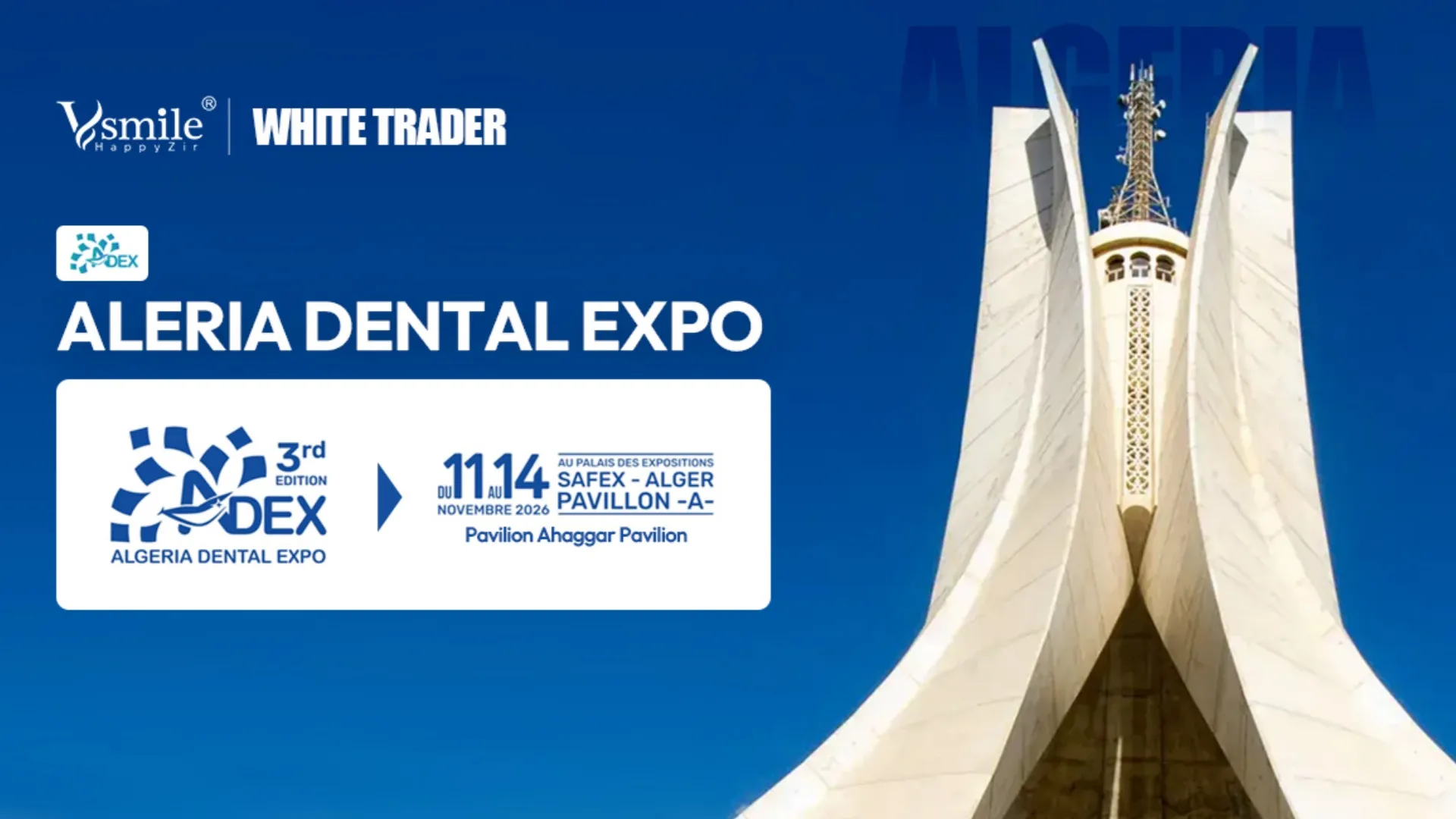
Vsmile is pleased to announce its participation in the 3rd Algerian Dental Expo (ADEX 2026), taking place from November 11 to 14, 2026, at the Palais des Expositions (SAFEX) in Algiers, Algeria.
At this year's exhibition, Vsmile will join its local distribution partner, WHITE TRADER, at Pavillon A. Together, the teams will connect with dental professionals and showcase dental materials, CAD/CAM solutions and practical applications for modern dental laboratory workflows.
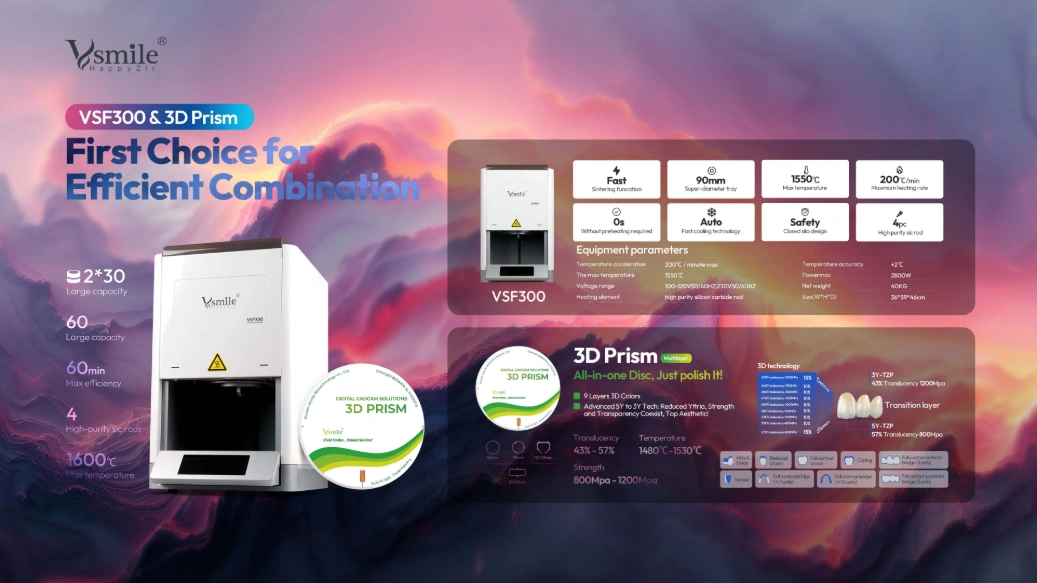
This bundle combines the powerful VSF300 fast sintering furnace with 4 pcs of 3D Prism multilayer zirconia blocks, delivering speed, capacity, and consistent esthetics in one package.
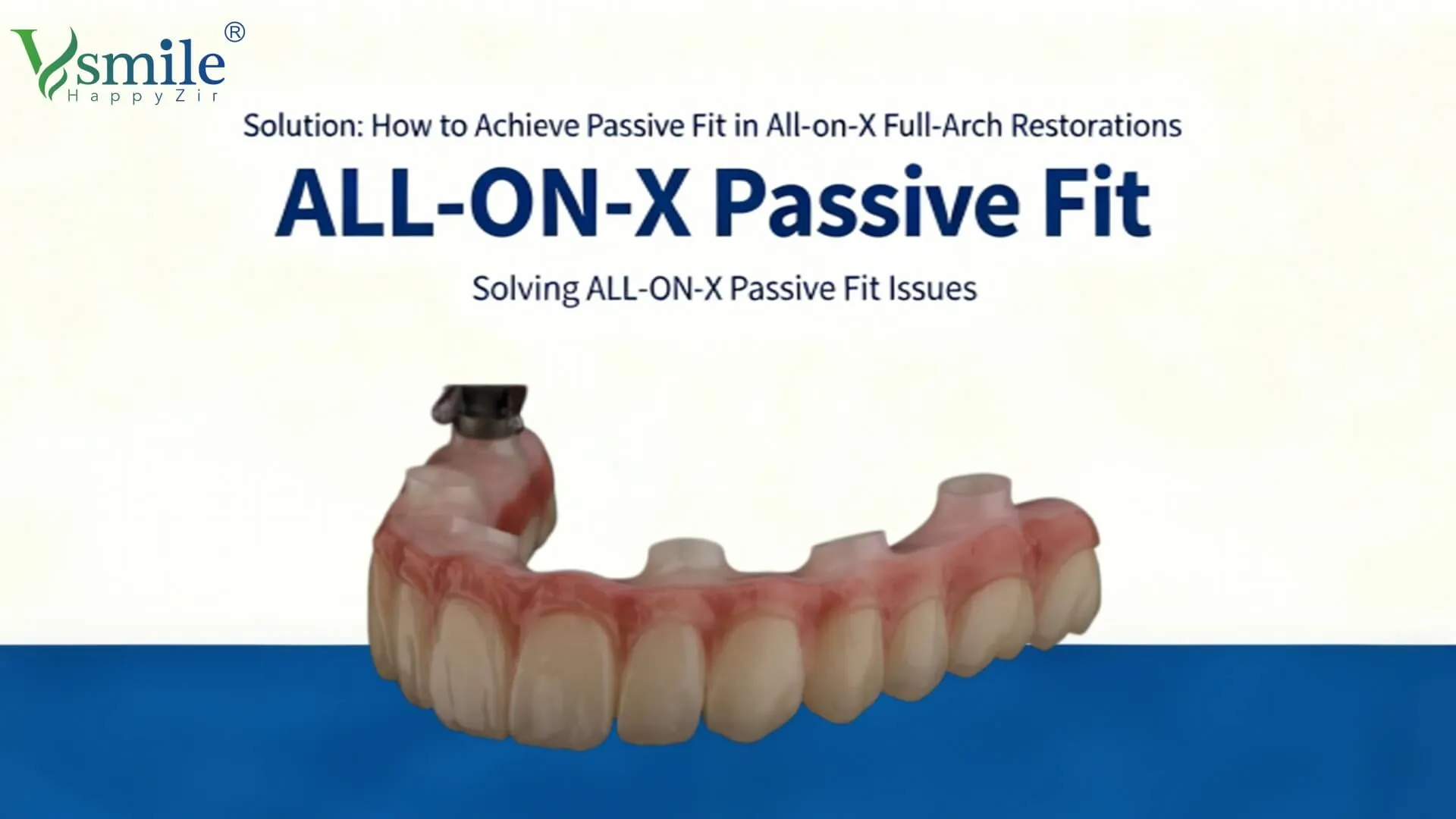
Passive fit failure is rarely caused by a single factor. Instead, it is the result of error stacking across the entire digital and manufacturing workflow.
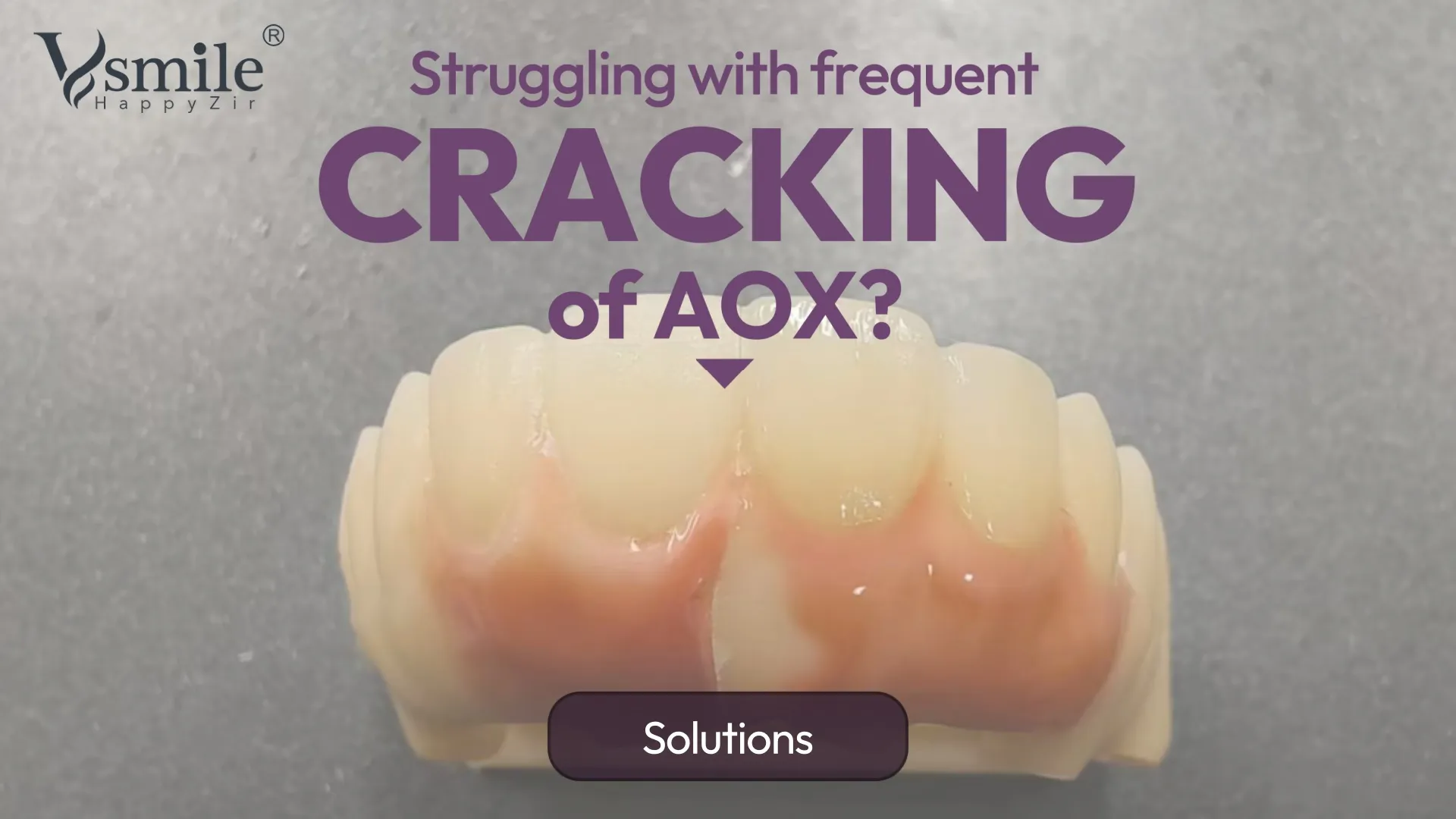
Fracture and microcracks are among the most critical failure modes in All-on-X (AOX) zirconia restorations.
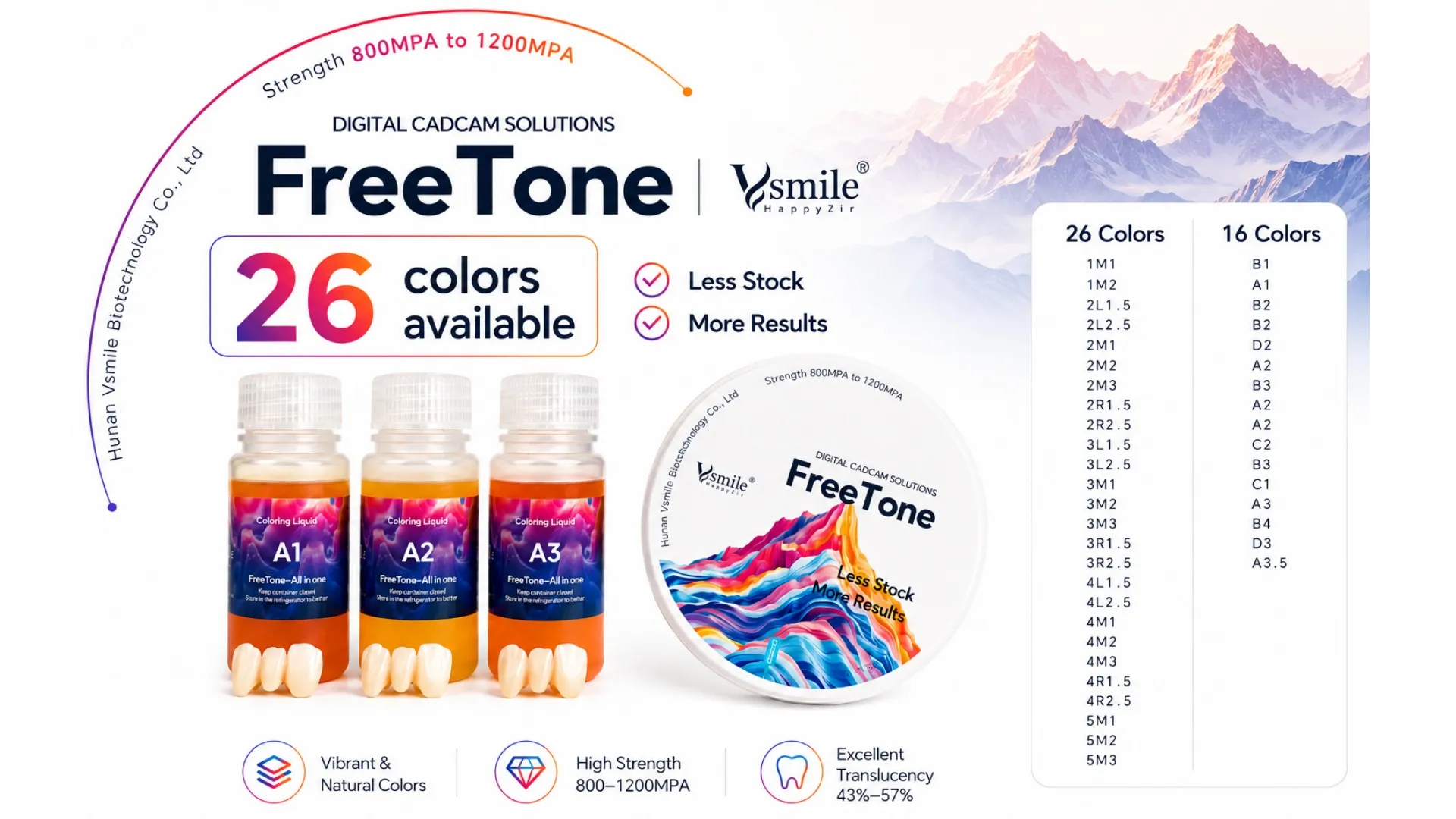
Whether you're crafting A1 or D4, FreeTone White Zirconia Disc gives you total shade control with just one SKU — streamlining inventory and increasing productivity.

Voices from Vsmile Global Partners — Stories of Trust, Growth, and Smiles We Create Together.
Long-span and full-arch restorations represent some of the most complex and failure-prone procedures in digital dentistry. Challenges include connector fractures, marginal misfits, sintering deformation, and low clinical longevity. Labs and clinics face a high rate of remakes, increased cost, and pressure to maintain quality under tight delivery deadlines.
2025.5.22

Vsmile offers a complete, validated digital workflow — from scanning to final zirconia bridge — that helps labs and clinics deliver life-changing smiles faster, with greater confidence and repeatable quality.


Tel: +86-731-85682958
Fax: +86-731-85682958
WhatsApp: +8615084896166/+8618569525651
Email: [email protected]
Address:
Room 1202-1203, Building A4,Huanchuang Corporate Park,No.2450, Yuelu West Avenue, Changsha Hi-tech Development District, Changsha, China.






























 EN
 fr
 ru
 nl
 uk
 fil
 lo
 ko
 it
 es
 el
 pt
 de
 th
 be
 sq
 tr
 ar
 vi
 pl