Trusted by 6000+ Labs · ISO13485 Certified · Fast Delivery from 3 Factories


Full dentures have entered a new digital era. With CAD/CAM technology, PMMA has become the material of choice for many dental labs and clinics producing full dentures, immediate dentures, and long-term provisional prosthetics.
But many professionals face a key question: should you use Single-layer PMMA, Double-layer PMMA, or Multilayer PMMA for full dentures, and what are the real differences in strength, esthetics, workflow, and cost?
This guide is written for dental labs, CAD-CAM labs, clinics, prosthodontic and implant centers, technicians, CAD-CAM operators, distributors, and dealers. It explains the differences clearly and practically, based on real lab workflows.
Before comparing layer structures, it is important to understand why PMMA (Polymethyl Methacrylate) is so popular in digital denture fabrication.
PMMA is commonly used for full dentures, immediate dentures, long-term temporaries, try-in dentures, and implant-supported provisional prosthetics.
However, not all PMMA discs are the same. Layer structure makes a significant difference.

Single-layer, Double-layer, and Multilayer PMMA refer to how color, translucency, and structure are distributed inside the PMMA disc.
Layer structure affects esthetics, strength, wear resistance, workflow efficiency, cost, and patient satisfaction.
Single-layer PMMA is made from one uniform layer of material with identical color, translucency, and density throughout the disc.
Single-layer PMMA has a flat and artificial appearance, limited esthetics without extra work, requires staining and polishing, and shows less natural gingival-to-tooth transitions.
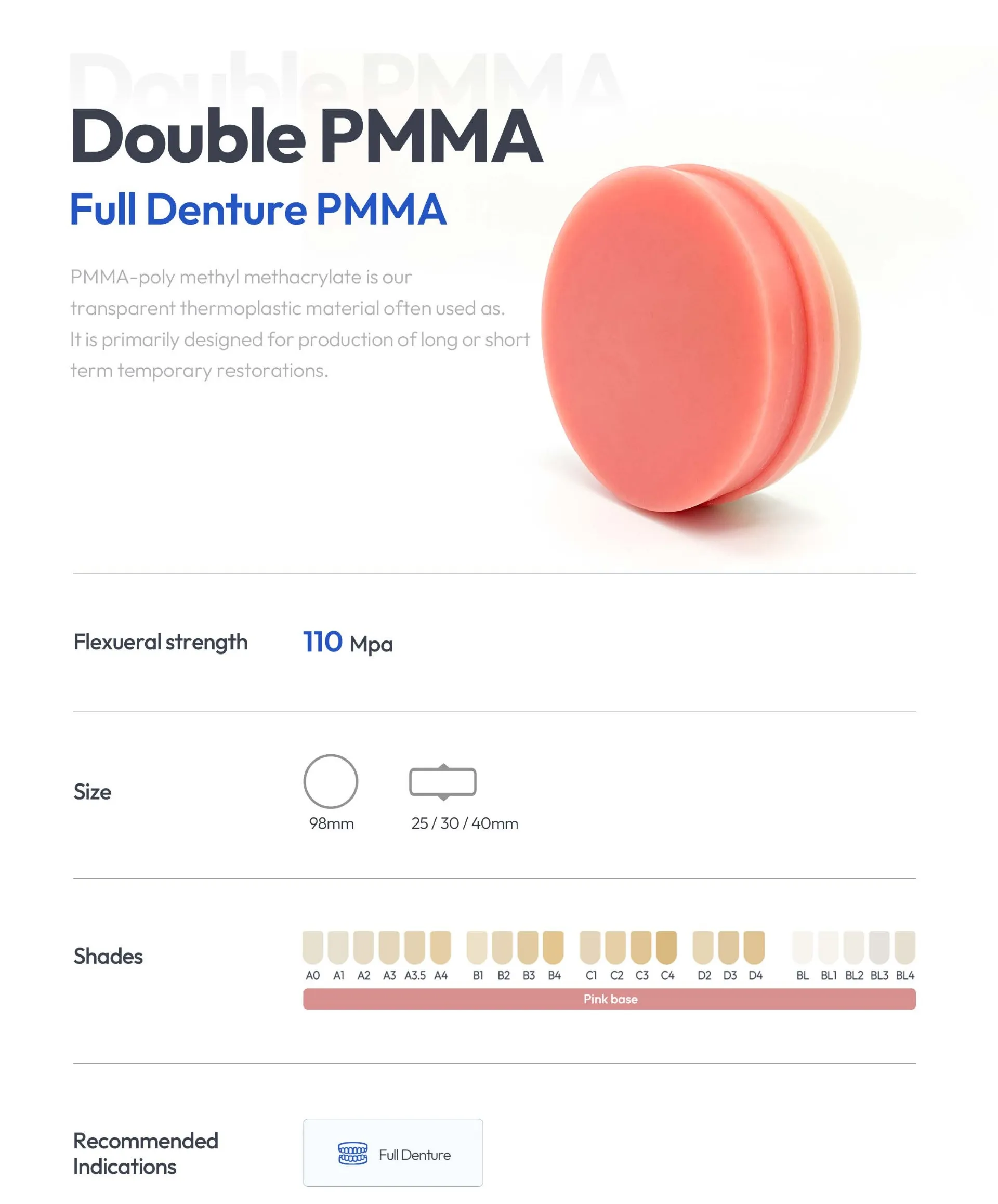
Double-layer PMMA consists of two distinct layers, typically a tooth layer with higher translucency and a gingiva layer with a more opaque pink shade.
Double-layer PMMA has limited shade gradients, less depth than Multilayer PMMA, and a fixed transition line that may appear artificial in some cases.
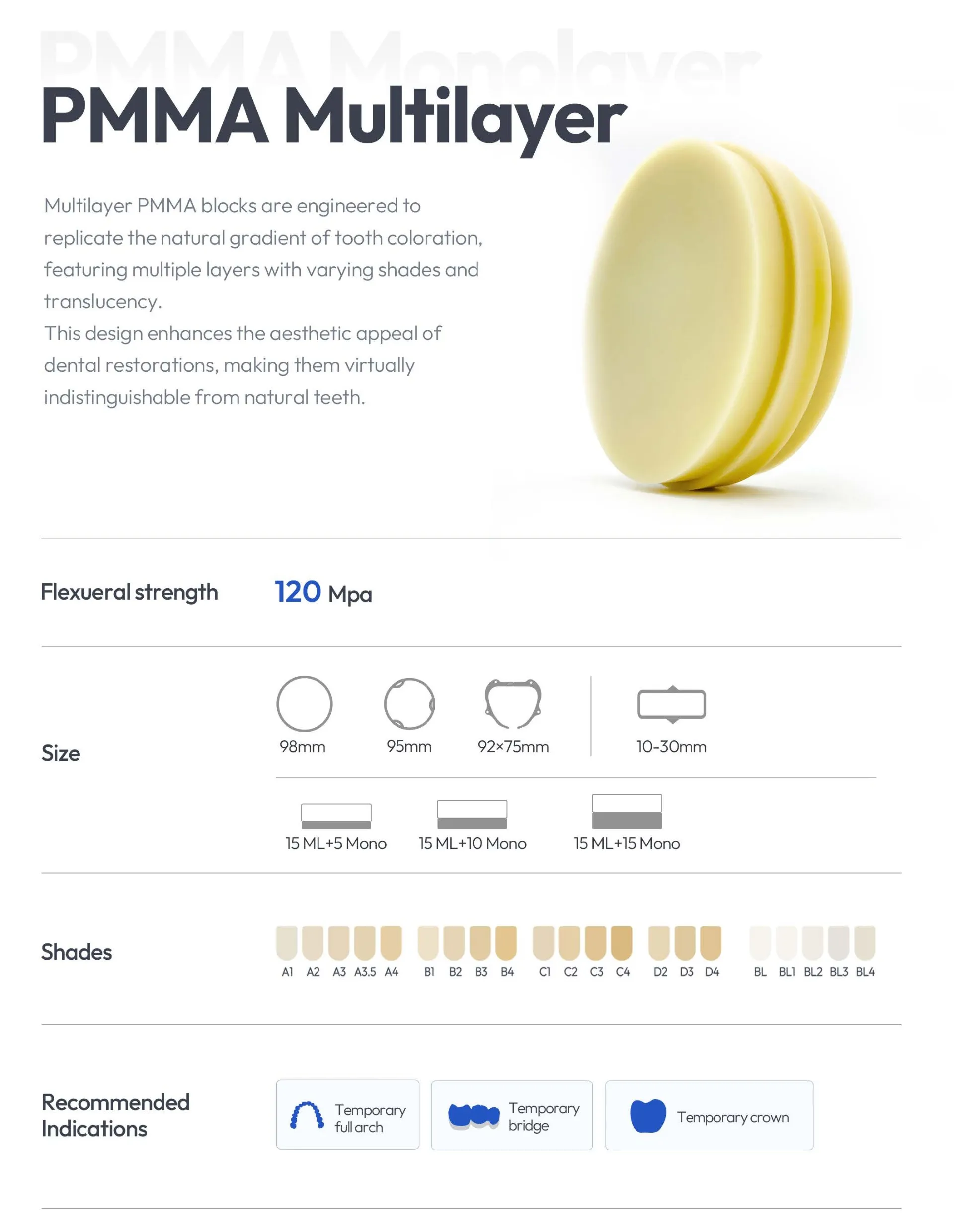
Multilayer PMMA is designed with multiple color and translucency layers that gradually transition from gingiva base through cervical, body, and incisal zones.
Multilayer PMMA has a higher material cost and requires precise positioning during CAD design, but the time savings often outweigh the added cost.
All PMMA types are mechanically reliable, but structure matters. Single-layer PMMA offers uniform strength, Double-layer PMMA provides balanced performance, and Multilayer PMMA often shows optimized stress distribution and improved wear resistance.
Milling followed by staining and polishing, with more manual steps and longer finishing time.
Milling with minor finishing and reduced staining requirements.
Milling with light polishing and minimal characterization, saving 20–40 minutes per case.
Although Multilayer PMMA costs more per disc, reduced labor, faster turnaround, and higher esthetic value often lead to better overall profitability.
It often shows better stress distribution and wear resistance.
Yes, especially for temporary or try-in dentures.
Multilayer PMMA provides the most natural appearance.
Yes, it balances esthetics and cost effectively.
Yes, it requires less staining and finishing.
Yes, particularly Multilayer PMMA for provisional restorations.
Choosing the right PMMA layer structure directly affects esthetics, workflow efficiency, and patient satisfaction.
Single-layer PMMA is simple and economical, Double-layer PMMA is balanced and practical, and Multilayer PMMA delivers premium esthetics and efficiency.
For modern digital denture workflows, Multilayer PMMA is increasingly becoming the preferred choice.

Vsmile is pleased to announce its participation in the 3rd Algerian Dental Expo (ADEX 2026), taking place from November 11 to 14, 2026, at the Palais des Expositions (SAFEX) in Algiers, Algeria.
At this year's exhibition, Vsmile will join its local distribution partner, WHITE TRADER, at Pavillon A. Together, the teams will connect with dental professionals and showcase dental materials, CAD/CAM solutions and practical applications for modern dental laboratory workflows.

This bundle combines the powerful VSF300 fast sintering furnace with 4 pcs of 3D Prism multilayer zirconia blocks, delivering speed, capacity, and consistent esthetics in one package.

Passive fit failure is rarely caused by a single factor. Instead, it is the result of error stacking across the entire digital and manufacturing workflow.

Fracture and microcracks are among the most critical failure modes in All-on-X (AOX) zirconia restorations.

Whether you're crafting A1 or D4, FreeTone White Zirconia Disc gives you total shade control with just one SKU — streamlining inventory and increasing productivity.

Voices from Vsmile Global Partners — Stories of Trust, Growth, and Smiles We Create Together.

Long-span and full-arch restorations represent some of the most complex and failure-prone procedures in digital dentistry. Challenges include connector fractures, marginal misfits, sintering deformation, and low clinical longevity. Labs and clinics face a high rate of remakes, increased cost, and pressure to maintain quality under tight delivery deadlines.
2025.5.22

Vsmile offers a complete, validated digital workflow — from scanning to final zirconia bridge — that helps labs and clinics deliver life-changing smiles faster, with greater confidence and repeatable quality.


Tel: +86-731-85682958
Fax: +86-731-85682958
WhatsApp: +8615084896166/+8618569525651
Email: [email protected]
Address:
Room 1202-1203, Building A4,Huanchuang Corporate Park,No.2450, Yuelu West Avenue, Changsha Hi-tech Development District, Changsha, China.



















































 EN
 fr
 ru
 nl
 uk
 fil
 lo
 ko
 it
 es
 el
 pt
 de
 th
 be
 sq
 tr
 ar
 vi
 pl