Trusted by 6000+ Labs · ISO13485 Certified · Fast Delivery from 3 Factories


As digital dentistry continues to grow rapidly in Peru, more dental laboratories are investing in CAD/CAM systems and zirconia restorations. However, with so many zirconia options on the market—different strengths, translucencies, layers, and prices—choosing the right zirconia can directly impact your lab’s efficiency, restoration quality, and profitability.
This guide is written specifically for Peruvian dental labs, milling centers, and dental technicians, to help you make a smarter, more practical decision.
Before choosing zirconia, the most important question is: what type of restorations does your lab produce most often?
In the Peruvian market, common indications include:
Single crowns (anterior & posterior)
Bridges (3–5 units)
Full-arch restorations
Implant-supported crowns
Different zirconia types serve different purposes:
High-strength zirconia (≥1200 MPa)
Ideal for posterior crowns and bridges where strength is critical.
High-translucency zirconia (800–1000 MPa)
Better for anterior crowns where esthetics matter more.
Multilayer zirconia
A popular choice in Peru because it balances strength and esthetics while reducing manual shading time.
Tip for labs:
If your lab handles mixed cases daily, a multilayer zirconia with gradient strength and translucency can reduce inventory complexity.
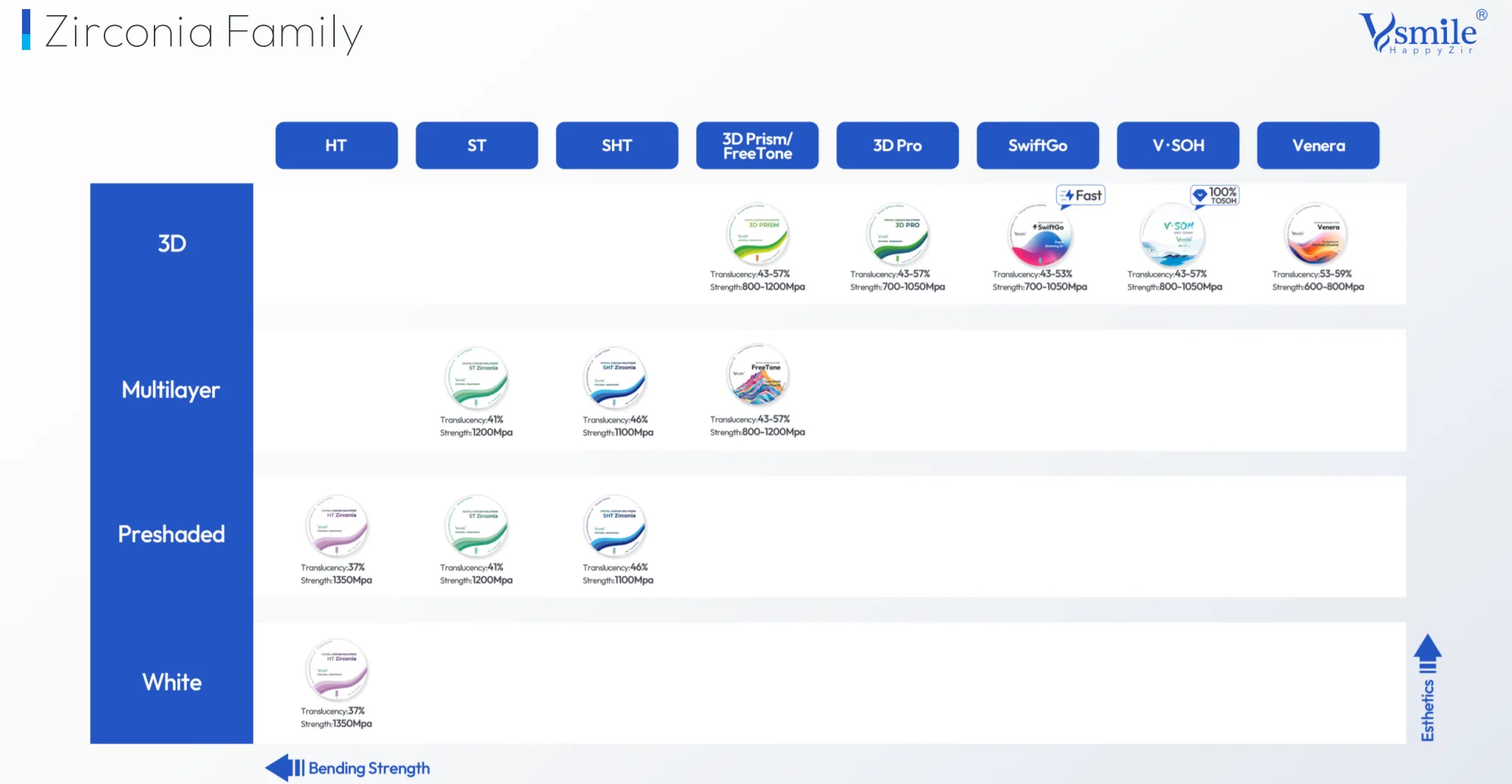
Many labs make the mistake of choosing zirconia based on only one parameter—either strength or translucency.
In real lab operations:
Ultra-high strength zirconia may look too opaque for anterior cases
Ultra-translucent zirconia may be risky for long-span bridges
For most Peruvian labs, the best solution is:
800–1200 MPa strength
Natural translucency (43%–57%)
Smooth color gradient from cervical to incisal
This balance ensures:
Fewer remakes
Better dentist satisfaction
Wider indication coverage
Not all zirconia blocks are universal.
Before ordering, confirm:
Disc diameter: 98 mm, 95 mm, or 92×75 mm
Thickness range required by your cases
Compatibility with machines commonly used in Peru (imes-icore, Roland, VHF, etc.)
Using incompatible zirconia can lead to:
Poor milling accuracy
Excessive tool wear
Unexpected fractures during sintering
Time is money in a dental lab.
Ask these questions:
What is the recommended sintering temperature?
Is the zirconia compatible with fast sintering furnaces?
Does it require special curves or long holding times?
For busy Peruvian labs handling high daily volumes, zirconia that supports rapid or flexible sintering cycles helps:
Increase daily output
Reduce energy costs
Improve delivery times to clinics
In Latin American markets like Peru, zirconia pricing can fluctuate due to:
Import costs
Logistics delays
Inconsistent suppliers
Choosing a zirconia supplier with:
Stable quality batches
Consistent color and shrinkage rate
Long-term export experience to Latin America
will help your lab avoid:
Color mismatches
Adjustment complaints
Rework caused by material inconsistency
Remember: the cheapest zirconia is rarely the most economical in the long run.
A reliable zirconia partner should provide:
Clear technical parameters
Sintering curves
Milling recommendations
Fast response to lab questions
For Peruvian labs expanding into digital workflows, strong technical support reduces learning costs and operational risks.
There is no “one-size-fits-all” zirconia.
The right zirconia for your dental lab in Peru should:
Match your main indications
Fit your milling system
Balance strength and esthetics
Support efficient production
Come from a stable, experienced supplier
Making the right choice helps your lab deliver consistent quality, improve dentist trust, and stay competitive in the growing Peruvian dental market.

Vsmile is pleased to announce its participation in the 3rd Algerian Dental Expo (ADEX 2026), taking place from November 11 to 14, 2026, at the Palais des Expositions (SAFEX) in Algiers, Algeria.
At this year's exhibition, Vsmile will join its local distribution partner, WHITE TRADER, at Pavillon A. Together, the teams will connect with dental professionals and showcase dental materials, CAD/CAM solutions and practical applications for modern dental laboratory workflows.

This bundle combines the powerful VSF300 fast sintering furnace with 4 pcs of 3D Prism multilayer zirconia blocks, delivering speed, capacity, and consistent esthetics in one package.

Passive fit failure is rarely caused by a single factor. Instead, it is the result of error stacking across the entire digital and manufacturing workflow.

Fracture and microcracks are among the most critical failure modes in All-on-X (AOX) zirconia restorations.

Whether you're crafting A1 or D4, FreeTone White Zirconia Disc gives you total shade control with just one SKU — streamlining inventory and increasing productivity.

Voices from Vsmile Global Partners — Stories of Trust, Growth, and Smiles We Create Together.

Long-span and full-arch restorations represent some of the most complex and failure-prone procedures in digital dentistry. Challenges include connector fractures, marginal misfits, sintering deformation, and low clinical longevity. Labs and clinics face a high rate of remakes, increased cost, and pressure to maintain quality under tight delivery deadlines.
2025.5.22

Vsmile offers a complete, validated digital workflow — from scanning to final zirconia bridge — that helps labs and clinics deliver life-changing smiles faster, with greater confidence and repeatable quality.


Tel: +86-731-85682958
Fax: +86-731-85682958
WhatsApp: +8615084896166/+8618569525651
Email: [email protected]
Address:
Room 1202-1203, Building A4,Huanchuang Corporate Park,No.2450, Yuelu West Avenue, Changsha Hi-tech Development District, Changsha, China.



















































 EN
 fr
 ru
 nl
 uk
 fil
 lo
 ko
 it
 es
 el
 pt
 de
 th
 be
 sq
 tr
 ar
 vi
 pl