Trusted by 6000+ Labs · ISO13485 Certified · Fast Delivery from 3 Factories


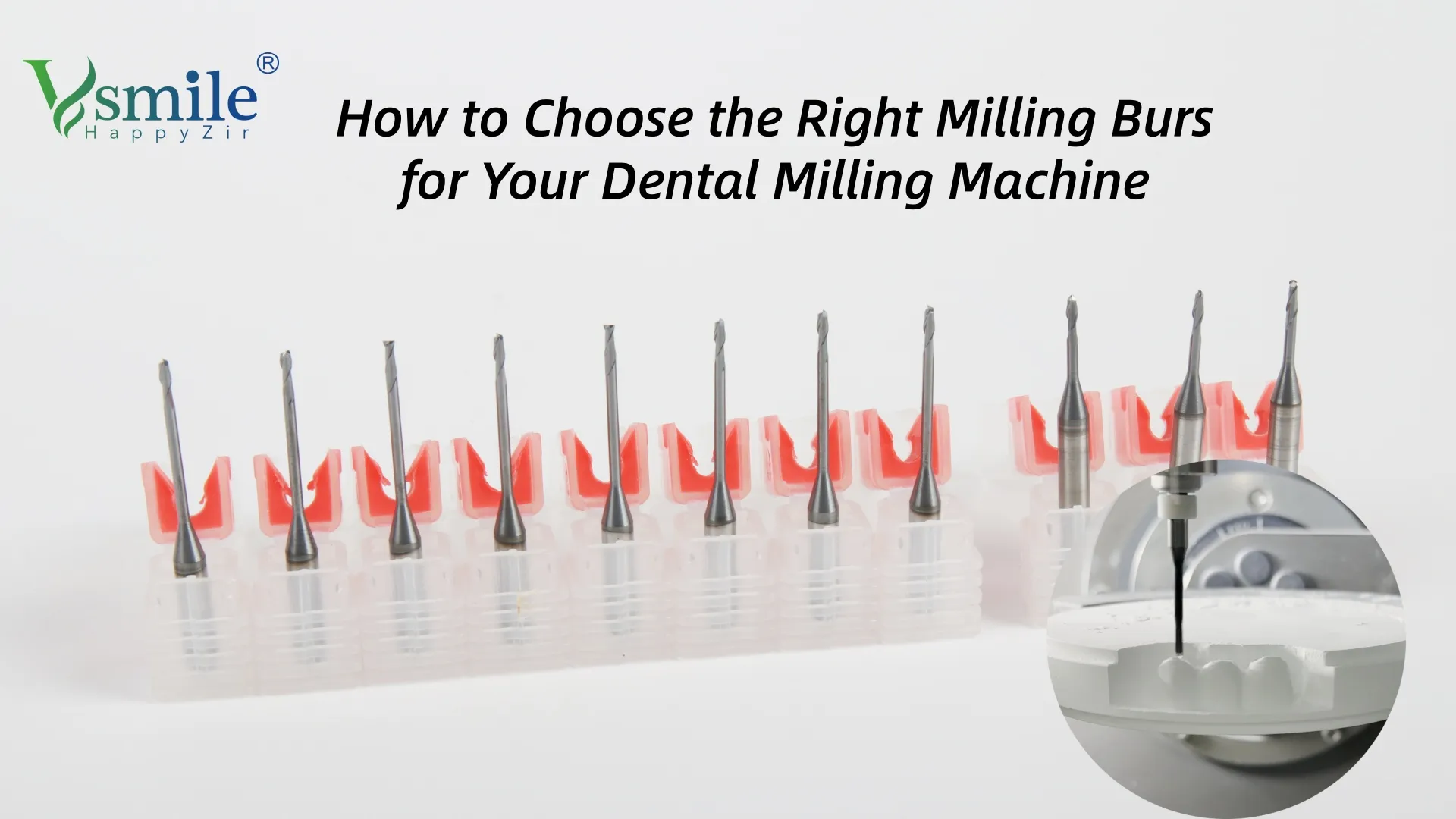
Selecting the right milling burs is one of the most important decisions for any dental lab or milling center. The right bur not only improves cutting performance and restoration quality but also significantly reduces your milling cost by extending tool life.
But with so many brands, sizes, coatings, and machine types, how do you choose the correct burs for your equipment?
This guide will walk you through everything you need to know — from basic parameters to coating technologies, bur types, and compatibility for popular milling machines.
Dental milling burs are precision tools used in dry or wet dental milling machines to cut materials such as zirconia, PMMA , PEEK, wax, titanium, and lithium disilicate.
Different applications require different bur shapes, sizes, and coatings to achieve the best results:
Zirconia: Needs high hardness & wear resistance
PMMA/Wax: Needs smooth cutting & anti-static design
Metal (Ti/CoCr): Needs high heat-resistance coating
Lithium disilicate: Needs diamond abrasive burs
Every milling bur has several essential parameters. Understanding them helps you quickly identify the correct bur for your milling machine.
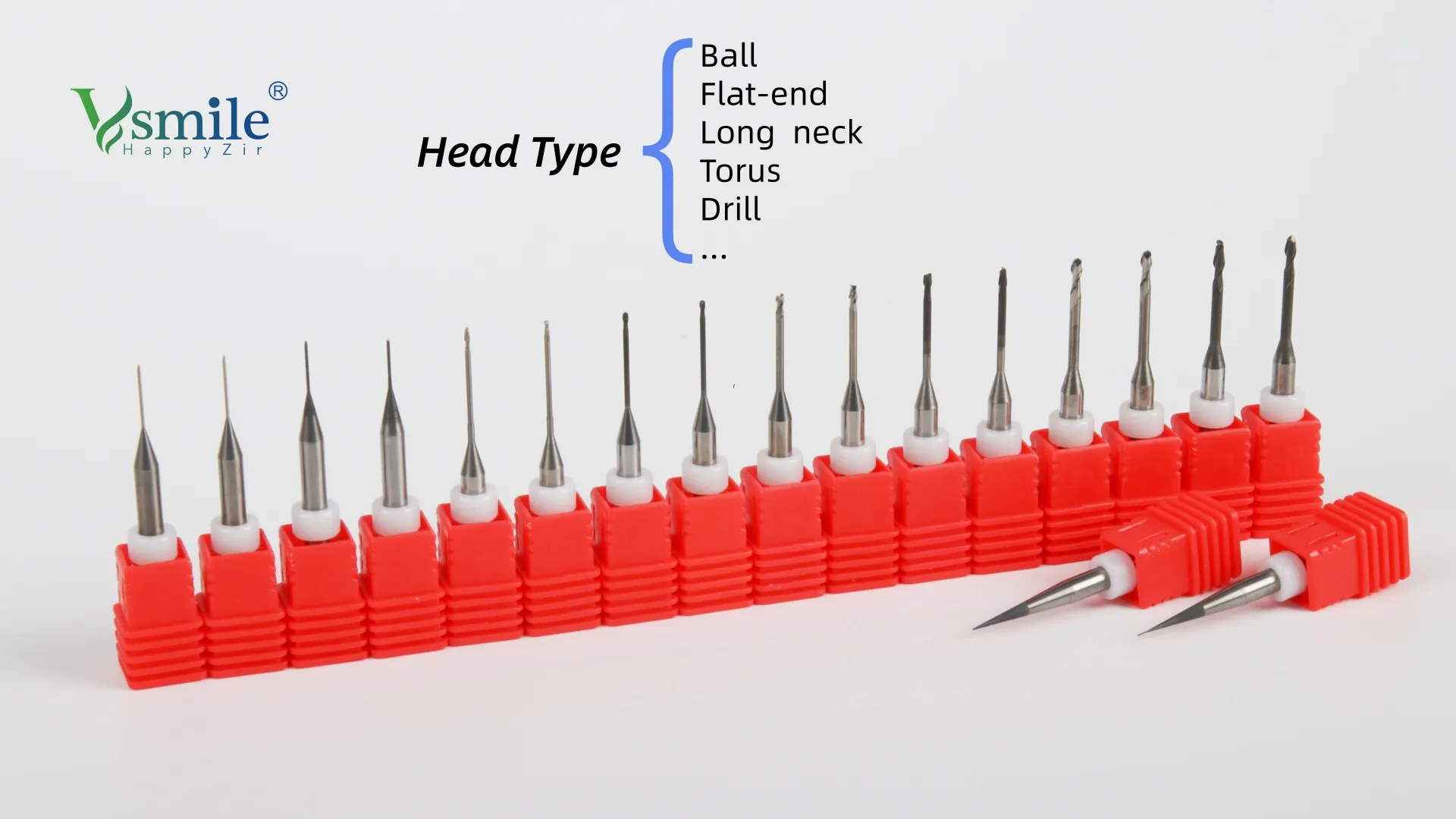
Determines the cutting function:
Flat end – roughing
Ball nose – finishing & fine detail
Spherical / tapered – special shapes for bridges, undercuts, and details
Common sizes: 2.5mm, 2.0mm, 1.0mm, 0.6mm
Large diameter → fast roughing
Small diameter → high-precision details
This MUST match your milling machine’s collet size.
Common standards:
3mm
4mm
6mm
If shank dia doesn’t match your spindle, you cannot use that bur.
Common lengths: 32mm, 35mm, 40mm, 43mm, 48mm, 47mm, 50mm, 57mm, etc.
Different machines use different lengths to ensure correct tool positioning.
Coating affects tool life, cutting quality, and material compatibility.
Common types include:
CVD Coating – ultra long life for zirconia (500–800 crowns)
Diamond Coating (DC) – best for abrasive materials like zirconia, PEEK, Wax
DLC (Diamond-Like Coating) – high hardness + thermal stability
TiSiN Coating – ideal for titanium & CoCr metal
NC (No coating) – engineered for PMMA/Wax to avoid static
Diamond Abrasive – for lithium disilicate ceramic
Each bur is optimized for specific materials.
Always check this parameter before purchasing.
Perhaps the most important factor:
Each milling machine model has unique bur size & shank standards.
Here is a quick overview of common bur standards:
Shank: 4mm
Length: 50mm
Materials: Zirconia, PMMA, Wax,
Typical burs: 0.3mm, 0.6mm, 1.0mm, 1.2mm ball nose
Shank: 3mm
Length: varies by series
Machines: K5, S5, R5, Z4
Supports Zirconia, PMMA, Wax,
Shank: 3mm / 6mm
Specialized burs for zirconia, PMMA, titanium, CoCr
| Coating Type | Recommended Application | Lifespan | Special Features |
| CVD (Chemical Vapor Deposition) | Zirconia | 500-800(Crowns) | Extends tool life and enhances cutting efficiency via chemical vapor deposition. |
| DC (Diamond Coating) | Zirconia, Acrylic, PEEK, Wax | 300-500(Crowns) | Offers superior performance for abrasive materials with a diamond coating, significantly increasing tool lifespan. |
| DLC (Diamond-Like Coating) | Zirconia, Acrylic, PEEK, Wax | 120-150(Crowns) | Provides diamond-like hardness and thermal stability through a hydrogen-free carbon coating. |
| Metal(TiSiN) | Titanium/CoCr | 80-100/40 hours | A multi-layer coating for machining metals at high temperatures, offering excellent heat resistance. |
| NC | PMMA | 50 hours | Engineered for PMMA machining, it reduces friction and static, ensuring smooth milling. |
| Diamond Abrasive | Lithium Disilicate | 20(Crowns) | Specifically designed for efficiently machining lithium disilicate. |
Find your milling machine brand and series:
Roland
VHF
Imes-icore
Arum
Roland DWX series
…etc.
This is the most crucial compatibility step.
If these two parameters do not match → bur cannot be used.

Use our quick guide:
| Material | Best Coating |
|---|---|
| Zirconia | CVD / Diamond / DLC |
| PMMA / Wax | NC / DLC |
| Titanium / CoCr | TiSiN Metal Bur |
| Lithium Disilicate | Diamond Abrasive |
Check the specification sheet:
Head dia
Shank dia
Length
Compatible machine list
If all match → safe to use.
By understanding bur parameters, coating type, milling materials, and machine compatibility, you can confidently choose the right milling burs for your dental lab.
The correct burs will help you:
Improve milling accuracy
Reduce tool breakage
Extend bur lifespan
Lower overall milling cost
Improve restoration surface quality
If you need personalized recommendations, share your machine model + materials you mill, and I can help you select the best burs for your daily workflow

Vsmile is pleased to announce its participation in the 3rd Algerian Dental Expo (ADEX 2026), taking place from November 11 to 14, 2026, at the Palais des Expositions (SAFEX) in Algiers, Algeria.
At this year's exhibition, Vsmile will join its local distribution partner, WHITE TRADER, at Pavillon A. Together, the teams will connect with dental professionals and showcase dental materials, CAD/CAM solutions and practical applications for modern dental laboratory workflows.

This bundle combines the powerful VSF300 fast sintering furnace with 4 pcs of 3D Prism multilayer zirconia blocks, delivering speed, capacity, and consistent esthetics in one package.

Passive fit failure is rarely caused by a single factor. Instead, it is the result of error stacking across the entire digital and manufacturing workflow.

Fracture and microcracks are among the most critical failure modes in All-on-X (AOX) zirconia restorations.

Whether you're crafting A1 or D4, FreeTone White Zirconia Disc gives you total shade control with just one SKU — streamlining inventory and increasing productivity.

Voices from Vsmile Global Partners — Stories of Trust, Growth, and Smiles We Create Together.

Long-span and full-arch restorations represent some of the most complex and failure-prone procedures in digital dentistry. Challenges include connector fractures, marginal misfits, sintering deformation, and low clinical longevity. Labs and clinics face a high rate of remakes, increased cost, and pressure to maintain quality under tight delivery deadlines.
2025.5.22

Vsmile offers a complete, validated digital workflow — from scanning to final zirconia bridge — that helps labs and clinics deliver life-changing smiles faster, with greater confidence and repeatable quality.


Tel: +86-731-85682958
Fax: +86-731-85682958
WhatsApp: +8615084896166/+8618569525651
Email: [email protected]
Address:
Room 1202-1203, Building A4,Huanchuang Corporate Park,No.2450, Yuelu West Avenue, Changsha Hi-tech Development District, Changsha, China.



















































 EN
 fr
 ru
 nl
 uk
 fil
 lo
 ko
 it
 es
 el
 pt
 de
 th
 be
 sq
 tr
 ar
 vi
 pl