Trusted by 6000+ Labs · ISO13485 Certified · Fast Delivery from 3 Factories


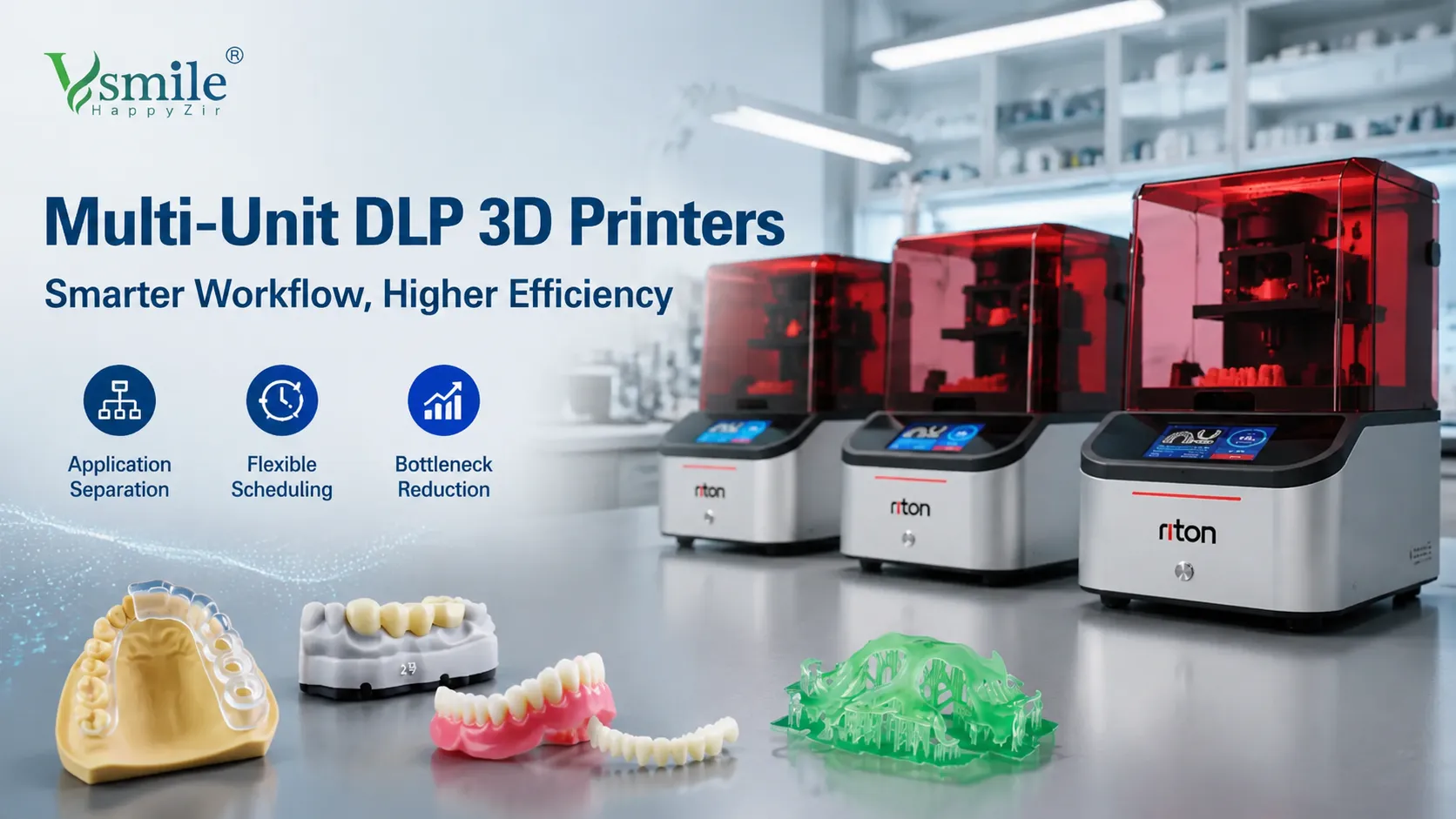
A dental lab usually does not lose time because one print is slow. It loses time because jobs queue up in the wrong order, resin changes interrupt operators, urgent guide cases compete with model batches, and one machine becomes the choke point for the whole day.
A multi-printer DLP workflow solves a different problem than simply buying a larger printer. It focuses on production flexibility, application separation, and reducing workflow bottlenecks.It lets the lab split production by application, keep urgent work moving, and reduce the damage when one printer is cleaning, calibrating, or waiting for resin. For labs printing surgical guides, splints, transparent parts, and detailed models, that flexibility can be more useful than raw build volume.
A single DLP printer can look efficient on paper and still slow a lab down in practice. The problem appears when one tray contains a surgical guide that needs careful resin handling, another job needs splint resin, and a model batch is waiting behind both. The printer is not idle, but the lab is still behind.
Multi-unit DLP printing gives the production manager more lanes. One printer can stay dedicated to surgical guides. Another can run splints or transparent applications. A third can handle detailed models or overflow work. The lab stops treating every case as a fight for the same machine.
DLP can be a strong option for precision-sensitive dental applications because its projection-based optical system allows manufacturers to optimize light distribution, calibration, and repeatability. A precision-focused Dental DLP 3D Printer such as the Vsmile VRP D130 gives labs a compact production cell for surgical guides, splints, transparent parts, and high-detail dental work.
The VRP D130 uses a 385 nm DLP projection system, automatic light calibration, smart monitoring for temperature, humidity, resin level and pressure, automatic resin feeding, and dual platform and dual vat design. In a single machine, those features reduce manual work. Across several machines, they help standardize how each station behaves.
| Printer count | Best-fit lab situation | Efficiency goal |
|---|---|---|
| 2 units | Small lab adding digital guide or splint capacity | Separate urgent precision cases from routine model or appliance work |
| 3 units | Growing labs with mixed applications | Dedicate machines by resin family or production priority |
| 4+ units | Large labs, production centers, or centralized manufacturing facilities | Build parallel queues and keep production running during cleaning or maintenance |
The simplest multi-unit plan is to assign each printer a job family. Put surgical guides on one unit, splints on another, and model or transparent work on another. That sounds basic, but it prevents the small time losses that accumulate all day: vat changes, parameter checks, cleaning routines, and operator hesitation.
Resin planning becomes easier too. If the lab uses several materials, review the validated Dental 3D Printing Resins before deciding how many printers to dedicate to each workflow. A lab that prints many guides should not plan the same way as a lab that mostly prints splints and diagnostic models.
Rush cases create bad production habits. A technician pauses a model batch, cleans the vat, switches resin, prints the urgent guide, then spends more time resetting the machine. The guide ships, but routine production falls behind.
A multi-unit setup gives urgent cases a cleaner path. The lab can reserve one DLP printer for time-sensitive guide or implant work while the other machines continue normal output. That separation protects both sides of the business: urgent clinical work and predictable daily throughput.
With several printers, inconsistency can sneak in fast. One unit is newly calibrated, another has drifted, and a third is being used by a different operator. If the lab does not standardize checks, it may not notice the problem until parts start failing fit inspection.
Automatic light calibration helps because it removes some of the guesswork from long-term accuracy. For a multi-unit DLP cell, buyers should ask how calibration is triggered, how long it takes, and how operators document that each unit is ready for production.
One printer can stop a department. Five smaller DLP printers rarely fail at the same time. That is the quiet advantage of a multi-unit plan: cleaning, maintenance, resin changeover, or one unexpected issue does not freeze every case in the queue.
This matters most for labs that sell turnaround time. If delivery reliability is part of the service promise, production capacity should not depend on one machine staying perfect every day.
Dental labs often print model resin, surgical guide resin, splint resin, gingiva mask resin, custom tray resin, and temporary crown and bridge materials (when validated for dental use) in the same week. A printer that accepts a wide material plan still needs a workflow that keeps materials clean and traceable. For mixed workflows, Dental 3D Printing Resin for LCD/DLP 3D Printer options can help the lab plan materials around real indications rather than generic resin categories.
Dual vat handling is useful here. A lab can keep common materials ready, reduce cleaning interruptions, and avoid rushing a resin switch when an operator is already under deadline pressure.
More printers create more output, but they also create more washing, curing, inspection, and finishing work. If those stations stay small, the bottleneck simply moves downstream. A lab expanding DLP capacity should check post-processing capacity, including a UV curing box for dental 3D printing post-processing, before adding every new unit. A dedicated UV curing unit helps laboratories achieve more consistent post-curing results when used with validated resin parameters.
The same logic applies upstream. Scan quality and file preparation need to keep pace with print capacity. Labs digitizing models or impressions should make sure capture equipment, such as a desktop 3D scanner for dental model impressions, can support the production schedule.
One large printer can make sense for model-heavy work. Multi-unit DLP makes more sense when the lab prints mixed materials, urgent precision cases, and parts that need different handling. The benefit is control. Each unit can carry a clearer job, a cleaner resin routine, and a more predictable inspection standard.
The tradeoff is management. Several printers need naming, scheduling, calibration records, resin logs, and operator habits that do not drift. If the lab is willing to run the cell with discipline, the payoff is a production floor that bends instead of breaking when the day gets messy.
Share your daily case mix, target turnaround time, resin families, and current bottleneck so the printer count and workflow can be matched to production instead of guesswork.
Many labs assume printing capacity is the limitation. In reality, the bottleneck may come from:
Adding printers without improving the upstream and downstream workflow may only move the bottleneck to another stage.
The required number depends on case volume, material types, turnaround requirements, and workflow organization. Many labs start with one printer and add additional units when different applications begin competing for production time.
It depends on case mix. One large printer can work well for model-heavy production. Multi-unit DLP is often better for mixed materials, urgent cases, and applications that need different resin handling.
Standardize resin parameters, calibration checks, vat handling, cleaning routines, post-curing, acceptance criteria, and operator training. Without that discipline, several printers can create several versions of the same problem.
Usually to washing, curing, finishing, inspection, or file preparation. Plan those stations before adding more print capacity.
Multi-unit DLP printing is not about filling the room with machines. It is about giving the lab more controlled production lanes. When guide work, splints, transparent parts, and detailed models stop fighting for the same printer, the day gets easier to manage.
For labs planning that kind of expansion, Vsmile can support the discussion around DLP printers, resin choices, post-processing, training, and service. The most useful inquiry is specific: send the case mix, target turnaround time, resin list, and the bottleneck you want to remove.

Vsmile is pleased to announce its participation in the 3rd Algerian Dental Expo (ADEX 2026), taking place from November 11 to 14, 2026, at the Palais des Expositions (SAFEX) in Algiers, Algeria.
At this year's exhibition, Vsmile will join its local distribution partner, WHITE TRADER, at Pavillon A. Together, the teams will connect with dental professionals and showcase dental materials, CAD/CAM solutions and practical applications for modern dental laboratory workflows.

This bundle combines the powerful VSF300 fast sintering furnace with 4 pcs of 3D Prism multilayer zirconia blocks, delivering speed, capacity, and consistent esthetics in one package.

Passive fit failure is rarely caused by a single factor. Instead, it is the result of error stacking across the entire digital and manufacturing workflow.

Fracture and microcracks are among the most critical failure modes in All-on-X (AOX) zirconia restorations.

Whether you're crafting A1 or D4, FreeTone White Zirconia Disc gives you total shade control with just one SKU — streamlining inventory and increasing productivity.

Voices from Vsmile Global Partners — Stories of Trust, Growth, and Smiles We Create Together.

Long-span and full-arch restorations represent some of the most complex and failure-prone procedures in digital dentistry. Challenges include connector fractures, marginal misfits, sintering deformation, and low clinical longevity. Labs and clinics face a high rate of remakes, increased cost, and pressure to maintain quality under tight delivery deadlines.
2025.5.22

Vsmile offers a complete, validated digital workflow — from scanning to final zirconia bridge — that helps labs and clinics deliver life-changing smiles faster, with greater confidence and repeatable quality.


Tel: +86-731-85682958
Fax: +86-731-85682958
WhatsApp: +8615084896166/+8618569525651
Email: [email protected]
Address:
Room 1202-1203, Building A4,Huanchuang Corporate Park,No.2450, Yuelu West Avenue, Changsha Hi-tech Development District, Changsha, China.



















































 EN
 fr
 ru
 nl
 uk
 fil
 lo
 ko
 it
 es
 el
 pt
 de
 th
 be
 sq
 tr
 ar
 vi
 pl