Trusted by 6000+ Labs · ISO13485 Certified · Fast Delivery from 3 Factories


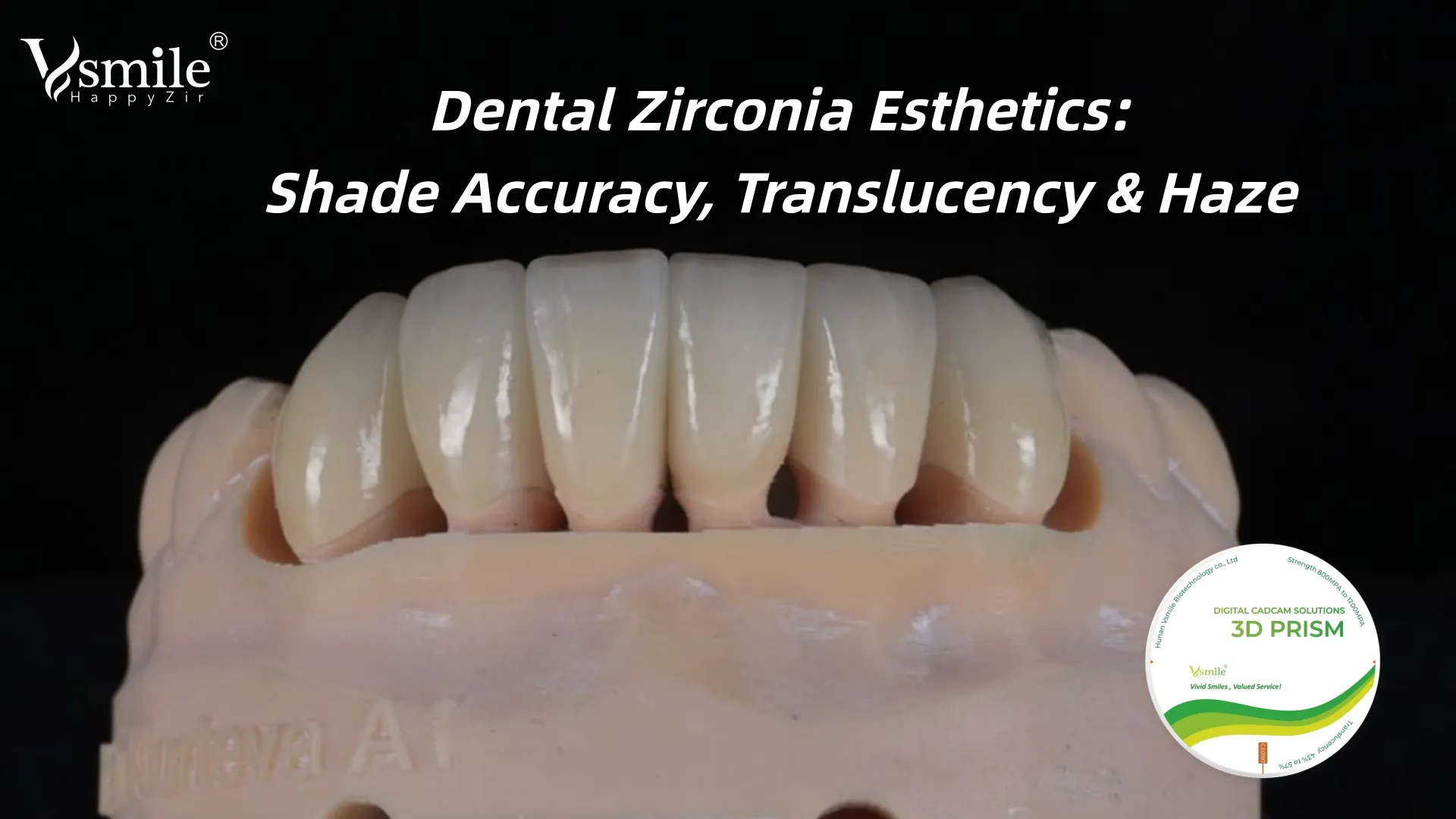
A zirconia restoration may have the correct shade on paper, but does it look natural after sintering?
For dental laboratories and milling centers, achieving a beautiful zirconia restoration involves more than selecting an A1, A2, or B1 shade. The final appearance depends on several factors, including zirconia composition, powder quality, microstructure, restoration thickness, coloring methods, and sintering conditions.
Some zirconia restorations look too white or opaque. Others allow light to pass through but still appear cloudy or lack visual depth.
So, what makes zirconia look naturally beautiful?
In this guide, we explain the relationship between zirconia shade accuracy, translucency, haze, and sintering performance, and what dental professionals should consider when choosing zirconia blocks.
Natural teeth do not look like solid white objects. Their appearance comes from the interaction of light with enamel, dentin, and internal tooth structures.
Enamel allows light to pass through, while dentin contributes much of the tooth's underlying color and opacity. Together, they create depth, subtle color variations, and natural optical effects.
A natural-looking zirconia restoration should aim to reproduce these visual characteristics.
Three important factors are:
Shade accuracy: How closely the restoration matches the intended tooth shade.
Translucency: How much light passes through the zirconia material.
Optical clarity: How clearly light passes through the material without excessive scattering.
These properties work together. High translucency alone does not guarantee a natural-looking restoration.
Translucency and haze are related optical properties, but they are not the same.
Translucency describes how much light can pass through a material while still being partially scattered.
Haze refers to the percentage of transmitted light that is scattered at wide angles, reducing image clarity when viewed through the material.
In simple terms:
Translucency describes how much light gets through.
Haze describes how much of that transmitted light becomes diffused.
Optical clarity describes how clearly objects and details can be seen through the material.
For dental restorations, these properties influence the way light interacts with the crown, particularly around the incisal edge and thinner areas.
A material that transmits light but produces excessive diffusion may not create the same visual clarity as one with better-controlled light scattering.
This is why dental laboratories should look beyond a single translucency percentage when evaluating zirconia blocks.
Several material-related factors influence the optical appearance of zirconia.
The yttria content of zirconia has a major influence on its crystalline structure, strength, and translucency.
Generally:
3Y zirconia: Higher strength and toughness, with relatively lower translucency.
4Y zirconia: A balance between mechanical properties and improved translucency.
5Y zirconia: Higher translucency, but generally lower flexural strength and fracture toughness than conventional 3Y zirconia.
This means that higher translucency is not automatically better for every restoration.
For posterior bridges and full-arch restorations, mechanical requirements remain essential. For highly esthetic anterior restorations, optical properties may receive greater emphasis.
The correct choice depends on the restoration design, location, thickness, and clinical requirements.
The quality of zirconia begins before milling.
Powder characteristics, additives, particle distribution, compaction, and pre-sintering conditions influence the microstructure of the final material.
During sintering, zirconia particles densify and develop their final crystalline structure. Residual pores and differences in microstructure can influence how light travels through the ceramic.
Material formulation and manufacturing consistency therefore play an important role in achieving predictable optical performance.
At Vsmile, zirconia manufacturing uses a binder-free powder formulation and binder-free process, with the aim of reducing unnecessary material interference and achieving lower haze and more natural light transmission.
Rather than focusing only on a high translucency percentage, Vsmile emphasizes the overall optical appearance of the finished restoration.
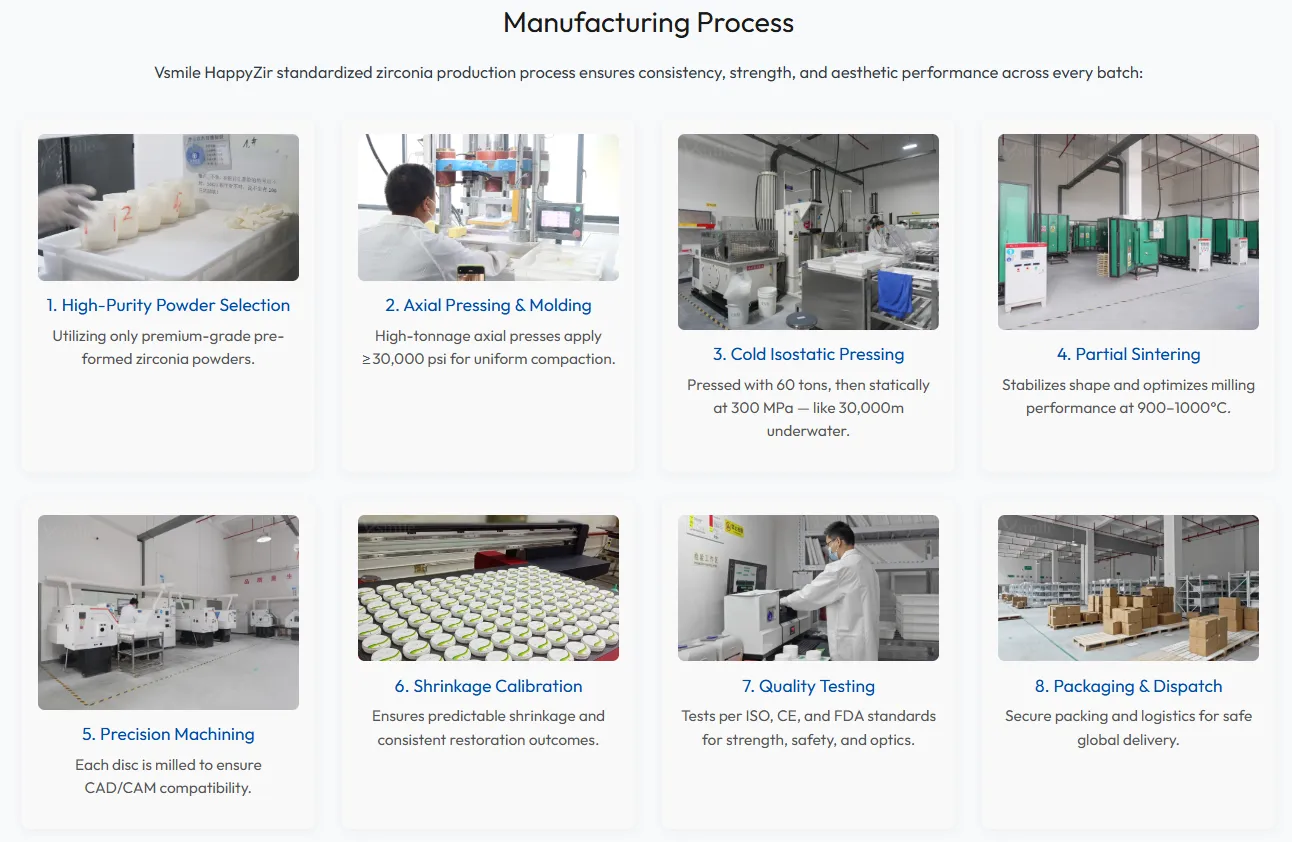
Zirconia is a polycrystalline ceramic.
When light passes through zirconia, it interacts with crystal grains, grain boundaries, and internal defects. These interactions can cause light scattering.
Factors such as grain size, phase composition, residual porosity, and material additives can affect the optical result.
This is one reason why two zirconia products with similar nominal translucency values may not necessarily look identical after sintering.
Sintering is a critical step in the production of zirconia restorations.
During this process, the pre-sintered zirconia is heated according to a specific temperature profile to achieve the required density and microstructure.
Several processing factors can influence the final appearance:
Sintering temperature
An unsuitable temperature may affect densification, grain growth, and optical properties.
Holding time
Insufficient or excessive holding time can change the final microstructure and potentially affect the restoration's color and translucency.
Heating and cooling rates
Different heating and cooling profiles may produce different optical and mechanical results, depending on the zirconia formulation.
Furnace calibration
The actual furnace temperature may differ from the displayed temperature. Proper calibration and maintenance are essential for repeatable results.
For this reason, dental laboratories should always follow the zirconia manufacturer's recommended sintering program rather than applying one universal curve to every material.
When comparing zirconia blocks, dental laboratories should consider more than the advertised shade range or translucency percentage.
Here are five practical evaluation points.
1. Compare the same shade
Use the same shade designation when comparing different zirconia products.
2. Control specimen thickness
Different thicknesses change light transmission. Keep sample dimensions consistent.
3. Use the same lighting and background
Observe samples under consistent lighting conditions and against both black and white backgrounds.
4. Compare after sintering
Evaluate the actual sintered specimens, not just the pre-sintered blocks.
5. Examine finished restorations
Look at the cervical, body, and incisal areas of actual crowns. Evaluate color transitions, translucency, optical clarity, and surface finish.
For more objective comparisons, laboratories can use spectrophotometers for color measurements and appropriate optical instruments for translucency and haze measurements.
A good zirconia material should deliver more than an attractive sample. It should support consistent results in daily laboratory production.
At Vsmile, we believe that zirconia quality should be evaluated by the final restoration, not just by a number on a product specification sheet.
Our binder-free powder formulation and manufacturing process are designed to support lower haze and more natural translucency.
Combined with carefully developed zirconia compositions and multilayer structures, Vsmile zirconia provides dental laboratories with material options for different esthetic and functional requirements.
Explore the Vsmile zirconia range:
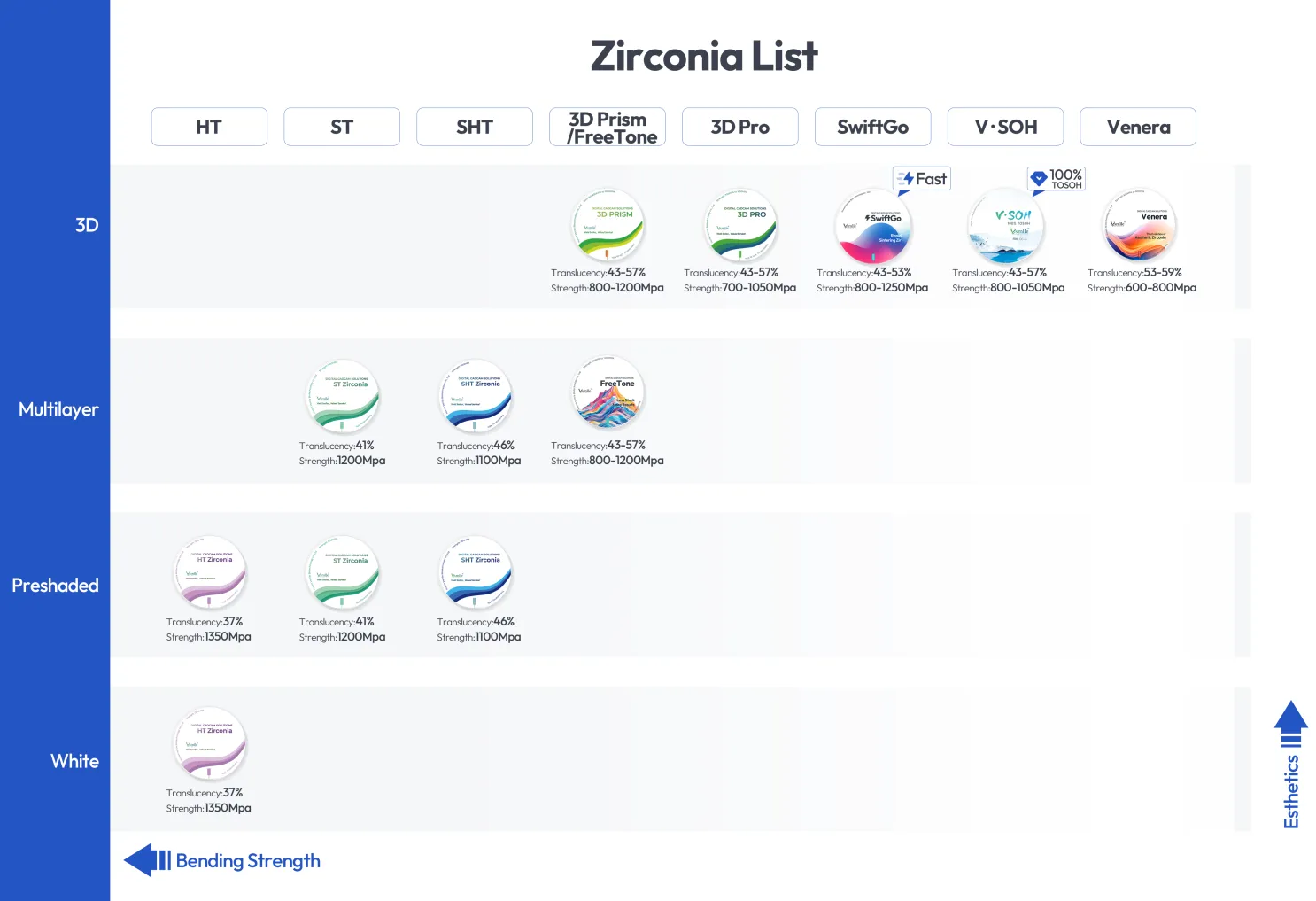
3D Prism Multilayer Zirconia: A nine-layer gradient structure combining different strength and translucency zones, designed to support natural-looking restorations.
3D Pro Multilayer Zirconia: A six-layer gradient solution for laboratories seeking a balance of strength and esthetics.
ST and SHT Zirconia: Options for different restoration requirements and optical preferences.
The right zirconia is not simply the most translucent one. It is the material that delivers the appropriate combination of strength, color, translucency, and predictable processing for each restoration.
No. Higher translucency can improve the natural appearance of some restorations, but it may come with reduced mechanical strength. Material selection should consider the clinical indication and restoration design.
Sintering changes the density and microstructure of pre-sintered zirconia. Temperature, holding time, heating rate, cooling rate, material composition, and coloring methods can influence the final color and translucency.
Haze is associated with light scattering inside the material. Grain boundaries, pores, phase distribution, additives, and other microstructural factors can influence the result.
Neither is universally better. 3Y is generally preferred when strength and toughness are priorities, while 5Y offers higher translucency for selected esthetic indications. The restoration's position, span, thickness, and loading conditions should guide the selection.
Natural-looking zirconia restorations are the result of multiple factors working together.
Shade accuracy, translucency, optical clarity, material composition, and controlled sintering all contribute to the final appearance.
For dental laboratories and milling centers, choosing zirconia should never be based on translucency alone.
Look beyond the shade label. Look beyond the percentage. Evaluate the material after sintering and examine the final restoration.
Vsmile — One-stop Solution for Perfect Smile.
Explore our zirconia solutions and discover how material quality can support more natural-looking dental restorations.

Vsmile is pleased to announce its participation in the 3rd Algerian Dental Expo (ADEX 2026), taking place from November 11 to 14, 2026, at the Palais des Expositions (SAFEX) in Algiers, Algeria.
At this year's exhibition, Vsmile will join its local distribution partner, WHITE TRADER, at Pavillon A. Together, the teams will connect with dental professionals and showcase dental materials, CAD/CAM solutions and practical applications for modern dental laboratory workflows.

This bundle combines the powerful VSF300 fast sintering furnace with 4 pcs of 3D Prism multilayer zirconia blocks, delivering speed, capacity, and consistent esthetics in one package.

Passive fit failure is rarely caused by a single factor. Instead, it is the result of error stacking across the entire digital and manufacturing workflow.

Fracture and microcracks are among the most critical failure modes in All-on-X (AOX) zirconia restorations.

Whether you're crafting A1 or D4, FreeTone White Zirconia Disc gives you total shade control with just one SKU — streamlining inventory and increasing productivity.

Voices from Vsmile Global Partners — Stories of Trust, Growth, and Smiles We Create Together.

Long-span and full-arch restorations represent some of the most complex and failure-prone procedures in digital dentistry. Challenges include connector fractures, marginal misfits, sintering deformation, and low clinical longevity. Labs and clinics face a high rate of remakes, increased cost, and pressure to maintain quality under tight delivery deadlines.
2025.5.22

Vsmile offers a complete, validated digital workflow — from scanning to final zirconia bridge — that helps labs and clinics deliver life-changing smiles faster, with greater confidence and repeatable quality.


Tel: +86-731-85682958
Fax: +86-731-85682958
WhatsApp: +8615084896166/+8618569525651
Email: [email protected]
Address:
Room 1202-1203, Building A4,Huanchuang Corporate Park,No.2450, Yuelu West Avenue, Changsha Hi-tech Development District, Changsha, China.




















































 EN
 fr
 ru
 nl
 uk
 fil
 lo
 ko
 it
 es
 el
 pt
 de
 th
 be
 sq
 tr
 ar
 vi
 pl