Trusted by 6000+ Labs · ISO13485 Certified · Fast Delivery from 3 Factories


If a zirconia crown, bridge, or full-arch restoration comes out of the furnace with excessive glaze, uneven shine, or overly dark external stains, many dental technicians immediately consider remaking the restoration. Fortunately, that is often unnecessary.
Yes, fired glaze and external stains can usually be corrected on zirconia restorations through controlled mechanical grinding, polishing, cleaning, and re-glazing when necessary.
For dental laboratories, understanding the correct rework process can reduce remakes, save production time, and improve consistency in zirconia finishing.
In this guide, we'll explain when glaze and stains can be removed, the recommended workflow, common mistakes to avoid, and how to choose the right diamond bur for each step.
Even experienced technicians occasionally encounter:
These issues are especially common when working with:
In many cases, the restoration itself remains clinically acceptable. Only the surface layer requires correction.
The short answer is:
Yes, but not by cleaning or brushing.
Once glaze and external stains have been fired, they become bonded to the zirconia surface.
As a result:
❌ Washing cannot remove them
❌ Steam cleaning cannot remove them
❌ Ultrasonic cleaning cannot remove them
✅ Controlled mechanical grinding can remove the surface layer
✅ Subsequent polishing can restore smoothness
✅ Re-glazing can restore gloss if needed
The objective is not to reshape the restoration but to remove only the superficial stain and glaze layer while preserving anatomy, margins, contacts, and occlusion.
Before any adjustment:
Check:
Mark the areas requiring correction.
Avoid unnecessary grinding of unaffected surfaces.
For broad facial or lingual surfaces:
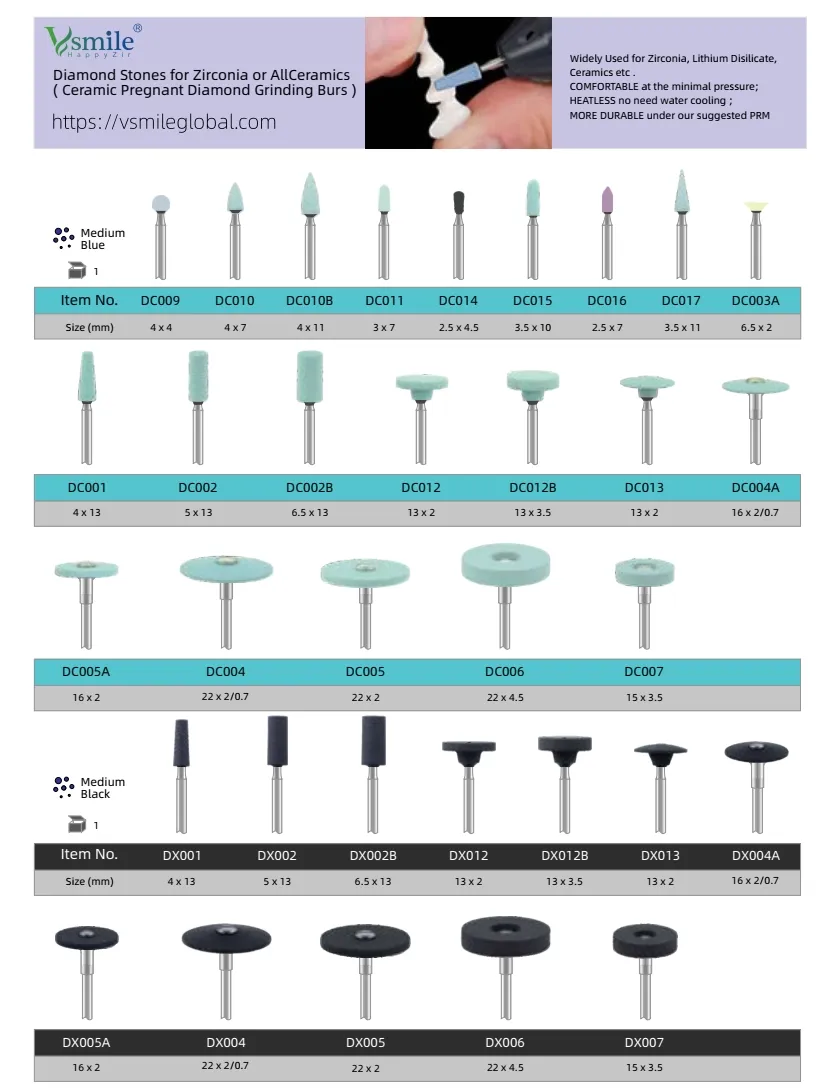
Recommended burs:
These cylindrical shapes allow technicians to reduce the glaze layer evenly without creating visible flat spots.
The goal is to achieve a uniform matte surface before polishing.
When stain is concentrated in fissures, grooves, or small anatomical details, more precise burs are recommended.
Recommended models:
These shapes provide better access to:
Work conservatively to avoid changing the intended anatomy.
After removing glaze or stain, surface transitions should be refined.
Recommended models:
These wheel-shaped burs help:
Special attention should be paid near:
This is one of the most important steps.
Many technicians focus on glaze removal but underestimate polishing.
After grinding:
A dedicated zirconia polishing system should be used:
Properly polished zirconia often performs as well as or better than glazed zirconia in long-term clinical use.
Before applying new stain or glaze:
Remove:
Common cleaning methods include:
The restoration should be completely clean and dry before any additional firing cycle.
A common misconception is that zirconia must always be re-glazed.
In reality:
A highly polished zirconia restoration may already have an excellent surface finish.
Re-glazing is recommended only when:
When applying glaze:
Thick glaze layers often cause the same esthetic problems that required correction in the first place.
External stain appears darker than intended after firing.
The restoration appears artificial due to an overly thick glaze layer.
Certain areas appear darker or more saturated than surrounding regions.
Yes. Fired glaze can usually be removed through controlled mechanical grinding followed by polishing and cleaning.
External stains can often be reduced or removed through surface grinding. Deep internal coloration may not be completely removable.
Not always. A properly polished zirconia surface can often be delivered without re-glazing.
For larger surfaces:
For detailed adjustments:
For surface blending:
Yes. Most over-stained zirconia restorations can be corrected by removing the surface stain layer, polishing, and reapplying stain if necessary.
Mistakes in staining and glazing do not always require a remake. In most situations, fired glaze and external stains can be corrected through a structured workflow involving controlled grinding, surface refinement, polishing, cleaning, and selective re-glazing.
For dental laboratories working with zirconia crowns, bridges, and full-arch restorations, establishing a standardized rework protocol can significantly reduce remake rates, improve production efficiency, and ensure more predictable esthetic results.
By selecting the correct diamond bur for each stage and following a systematic finishing process, technicians can confidently recover many restorations that might otherwise be discarded.

Vsmile is pleased to announce its participation in the 3rd Algerian Dental Expo (ADEX 2026), taking place from November 11 to 14, 2026, at the Palais des Expositions (SAFEX) in Algiers, Algeria.
At this year's exhibition, Vsmile will join its local distribution partner, WHITE TRADER, at Pavillon A. Together, the teams will connect with dental professionals and showcase dental materials, CAD/CAM solutions and practical applications for modern dental laboratory workflows.

This bundle combines the powerful VSF300 fast sintering furnace with 4 pcs of 3D Prism multilayer zirconia blocks, delivering speed, capacity, and consistent esthetics in one package.

Passive fit failure is rarely caused by a single factor. Instead, it is the result of error stacking across the entire digital and manufacturing workflow.

Fracture and microcracks are among the most critical failure modes in All-on-X (AOX) zirconia restorations.

Whether you're crafting A1 or D4, FreeTone White Zirconia Disc gives you total shade control with just one SKU — streamlining inventory and increasing productivity.

Voices from Vsmile Global Partners — Stories of Trust, Growth, and Smiles We Create Together.

Long-span and full-arch restorations represent some of the most complex and failure-prone procedures in digital dentistry. Challenges include connector fractures, marginal misfits, sintering deformation, and low clinical longevity. Labs and clinics face a high rate of remakes, increased cost, and pressure to maintain quality under tight delivery deadlines.
2025.5.22

Vsmile offers a complete, validated digital workflow — from scanning to final zirconia bridge — that helps labs and clinics deliver life-changing smiles faster, with greater confidence and repeatable quality.


Tel: +86-731-85682958
Fax: +86-731-85682958
WhatsApp: +8615084896166/+8618569525651
Email: [email protected]
Address:
Room 1202-1203, Building A4,Huanchuang Corporate Park,No.2450, Yuelu West Avenue, Changsha Hi-tech Development District, Changsha, China.



















































 EN
 fr
 ru
 nl
 uk
 fil
 lo
 ko
 it
 es
 el
 pt
 de
 th
 be
 sq
 tr
 ar
 vi
 pl