Trusted by 6000+ Labs · ISO13485 Certified · Fast Delivery from 3 Factories


When shopping for dental zirconia blocks, you may come across product names such as 3D, 4D and 5D zirconia.
A common assumption is that a higher D number automatically means a better material.
But is that really true?
Not necessarily.
Unlike 3Y, 4Y and 5Y, which refer to yttria-content categories in zirconia materials, the terms 3D, 4D and 5D are generally commercial product labels. Their meanings can vary between manufacturers. There is no universal industry definition that makes every 5D zirconia better than every 3D zirconia.
For dental laboratories, the more useful question is not simply how many D's a product has.
It is whether the zirconia offers the right combination of strength, translucency, shade performance and verified material properties for the intended restoration.
The terms 3D, 4D and 5D are used in the dental zirconia market to describe different product concepts and marketing positions.
However, they should not be confused with standardized material classifications.
For example:
3Y, 4Y and 5Y refer to different nominal yttria-content categories, usually expressed in mol%.
3D, 4D and 5D are commercial naming terms whose definitions depend on the manufacturer.
This distinction matters.
A higher D number does not automatically prove higher flexural strength, better translucency, more natural shades or greater fracture resistance.
When comparing products, dental professionals should look beyond the product name and review the actual formulation, multilayer structure, technical specifications and test methods.
Some zirconia products are promoted using five performance dimensions:
Strength
Translucency
Shades
Fracture toughness
Hardness
These properties describe different aspects of a material. They should not be treated as interchangeable or assumed to increase together.
Strength describes how much stress a material can withstand before failure under a specified test.
Flexural strength is a commonly reported property for dental zirconia. However, test methods, specimen dimensions, surface preparation and testing conditions can affect reported values.
Translucency describes how light passes through a material.
It influences the optical appearance of a restoration and its ability to blend with surrounding natural teeth.
Higher translucency can be desirable for some esthetic situations, but it is not automatically better for every case.
Shade performance includes color, shade transitions and the visual relationship between different regions of a restoration.
For multilayer zirconia, shade design can help create a more natural transition from the cervical region to the incisal region.
Fracture toughness describes a material's resistance to crack propagation.
It is not the same as flexural strength. Two materials can have different strength and fracture-toughness values, and both properties are relevant when evaluating mechanical performance.
Hardness measures resistance to localized indentation or surface deformation.
It is relevant to material characterization and can also be considered in relation to machining and wear behavior. In dental applications, surface finishing and polishing are important when evaluating potential wear against opposing teeth.
The key point: These properties provide different information. A product should be evaluated using the properties that matter to its intended application, supported by appropriate test data.
At VSMILE, we use the 3D concept to make zirconia selection easier to understand.
Rather than encouraging laboratories to chase a higher D number, we focus on three practical dimensions:
Does the material provide mechanical performance appropriate for the intended restoration?
Strength-related specifications should be reviewed alongside restoration design, dimensions, connector geometry and the manufacturer's indications.
Does the material offer the optical characteristics required for the case?
Translucency influences how the restoration interacts with light and the underlying tooth or abutment.
Does the material provide the shade and gradient design needed for the desired restoration?
A well-designed multilayer block can help laboratories achieve a more natural-looking transition across the restoration.
These three dimensions provide a practical starting point for material selection.
This does not mean that other material properties are unimportant. Fracture toughness, hardness, aging behavior and other technical characteristics remain part of a complete material evaluation.
VSMILE 3D is about focusing the selection conversation—not leaving out the science.
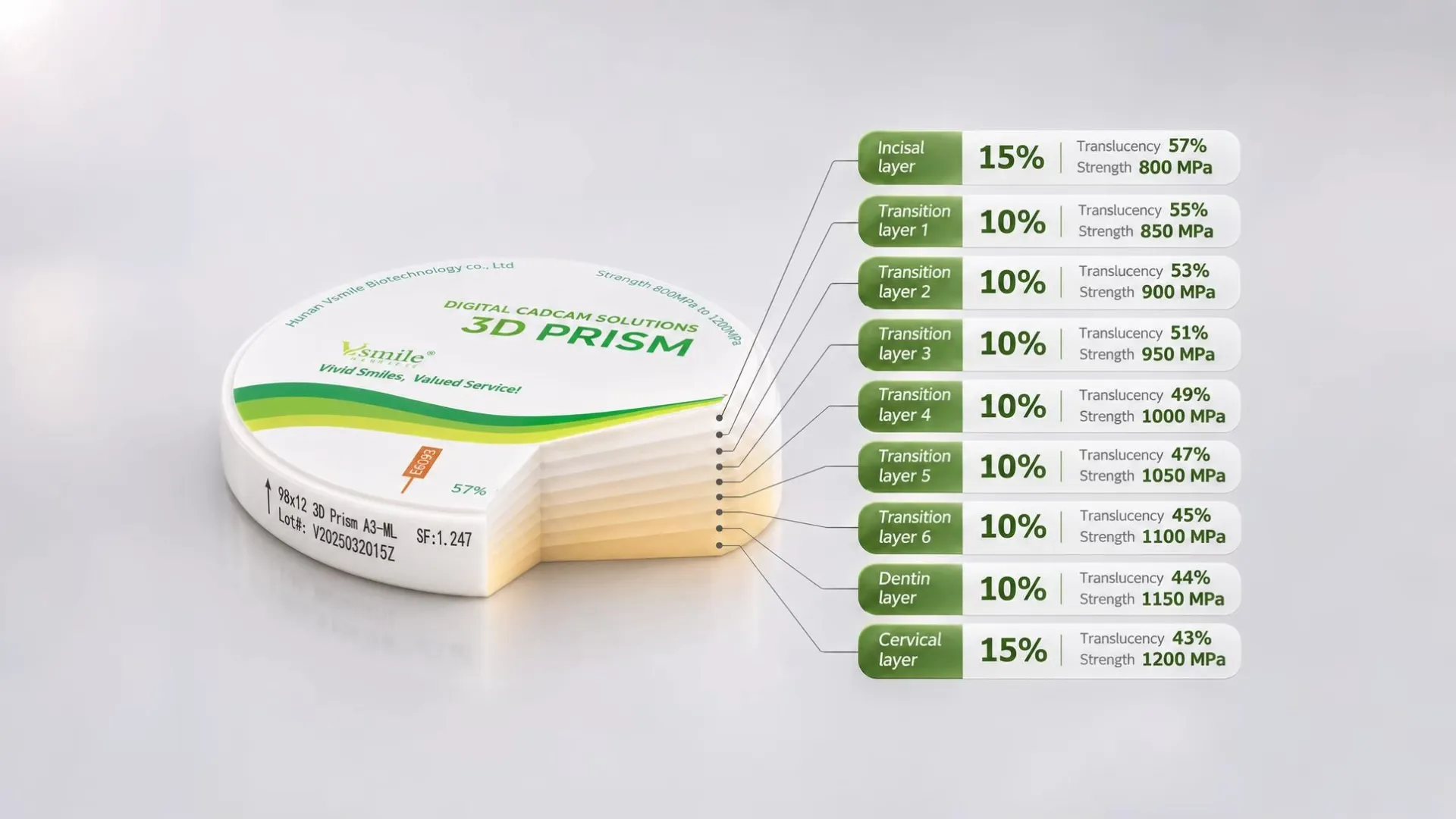
Multilayer zirconia is designed to provide different optical or material characteristics across the thickness of a block.
But not all multilayer zirconia uses the same technology.
Two important concepts should be understood.
Shade-gradient technology uses color design to create transitions across different regions of a zirconia block.
For example, the cervical region may have a stronger dentin-like shade, while the incisal region is designed with a lighter or more translucent appearance.
The purpose is to help reproduce the natural visual transition of a tooth.
Composition-gradient technology uses different material compositions in different regions of the block.
Some products may use different yttria-content zirconia regions, such as 3Y, 4Y or 5Y, to create variations in mechanical and optical characteristics.
Because the material composition changes across the block, the properties may also vary from one region to another.
Some multilayer products combine shade design and composition gradients.
This approach can consider several factors together:
Material composition
Mechanical characteristics
Translucency
Cervical-to-incisal shade transitions
Final sintered appearance
The number of layers alone does not determine the quality of a multilayer zirconia block. What matters is how the layers are designed, controlled and validated.
No universal rule says that 5D is always better than 4D or 3D.
The D number is a product label, not a standardized measurement of material quality.
A higher number does not automatically mean:
Higher flexural strength
Higher fracture toughness
Better translucency
More accurate shades
Better sintering performance
Better clinical outcomes
For a meaningful comparison, ask the manufacturer to explain what each D level represents and request product-specific technical evidence.
A good comparison should include the same test method, specimen dimensions, surface condition and measurement conditions wherever possible.
Before choosing a zirconia block, consider these questions:
Material composition
What is the yttria-content category?
Is the product a uniform-composition or composition-gradient zirconia?
What is the actual multilayer design?
Mechanical properties
What is the reported flexural strength?
Is fracture toughness available?
What test methods and conditions were used?
Optical properties
Is translucency measured at a specified specimen thickness?
Are shade and color-transition samples available?
Can the supplier provide comparable before-and-after-sintering examples?
Manufacturing and quality
Are production and sintering instructions clearly defined?
Is dimensional shrinkage controlled?
Is batch consistency monitored?
Are quality records and relevant regulatory documents available?
These questions help dental laboratories evaluate the material itself rather than relying only on a product name.
At VSMILE, we believe that good zirconia selection should begin with understanding the material.
Our 3D concept focuses on three practical dimensions:
Strength. Translucency. Shades.
They help dental laboratories understand the mechanical, optical and color-related aspects of material selection.
But a responsible material evaluation goes further.
Fracture toughness, hardness, aging behavior, manufacturing consistency and product-specific testing also matter.
We do not believe that a higher D number automatically makes a better zirconia block.
We believe in understanding the design, evaluating the performance and selecting the right material for the intended application.
Good zirconia is not about chasing more numbers. It is about the right balance, supported by evidence.
Explore VSMILE zirconia solutions for dental laboratories, milling centers and distributors.
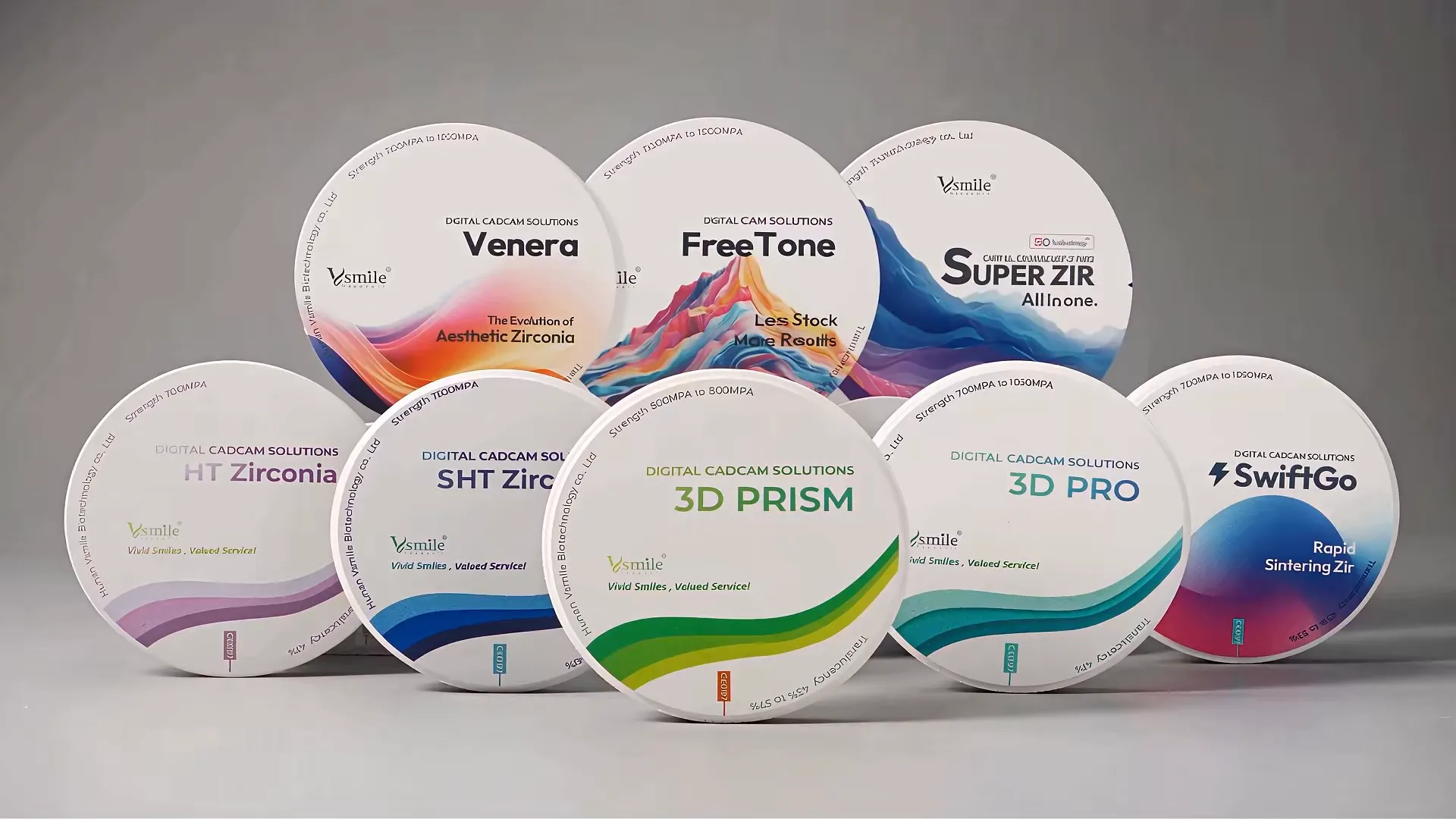
Not automatically. 3D and 5D are commercial product labels without a universal industry definition. Compare the actual material properties, multilayer design and test data before deciding.
3D is generally a commercial product name, while 3Y refers to a zirconia material category with approximately 3 mol% yttria. They describe different things.
VSMILE 3D is a product communication concept focused on three practical material-selection dimensions: strength, translucency and shades.
Yes. Fracture toughness and hardness are material properties, not features that exist only in products named 4D or 5D. Their actual values must be evaluated using product-specific technical data.
Multilayer zirconia is a zirconia block designed with different regions or layers. Depending on the product, these differences may involve shade, translucency, material composition or a combination of these factors.
Not necessarily. Layer count alone does not establish material quality. Layer design, composition, transition, manufacturing control and final sintered performance are all important.
Compare the intended application, material composition, flexural strength, translucency, shade performance, fracture toughness, sintering requirements, batch consistency and supporting quality documentation.
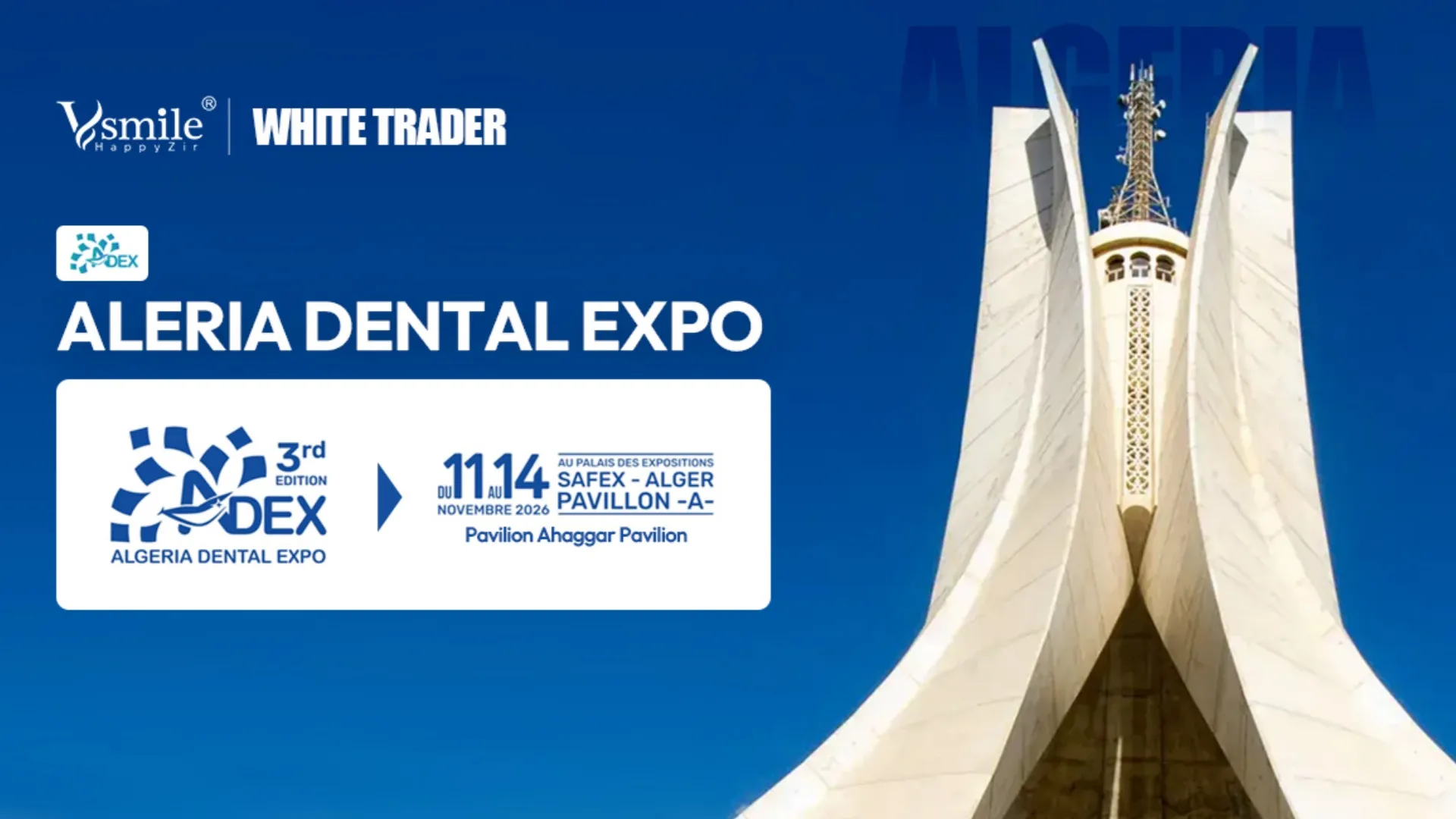
Vsmile is pleased to announce its participation in the 3rd Algerian Dental Expo (ADEX 2026), taking place from November 11 to 14, 2026, at the Palais des Expositions (SAFEX) in Algiers, Algeria.
At this year's exhibition, Vsmile will join its local distribution partner, WHITE TRADER, at Pavillon A. Together, the teams will connect with dental professionals and showcase dental materials, CAD/CAM solutions and practical applications for modern dental laboratory workflows.
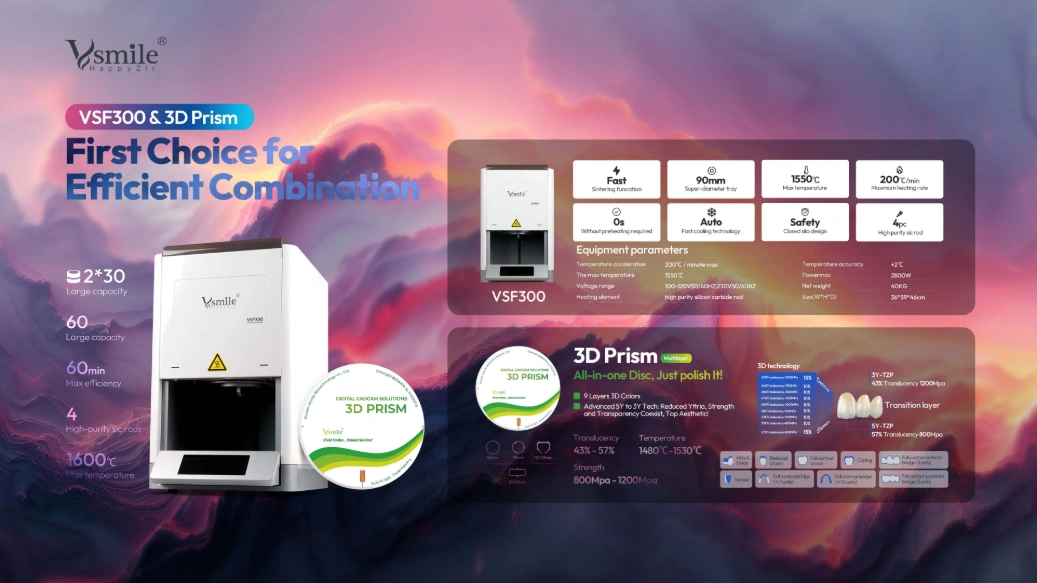
This bundle combines the powerful VSF300 fast sintering furnace with 4 pcs of 3D Prism multilayer zirconia blocks, delivering speed, capacity, and consistent esthetics in one package.
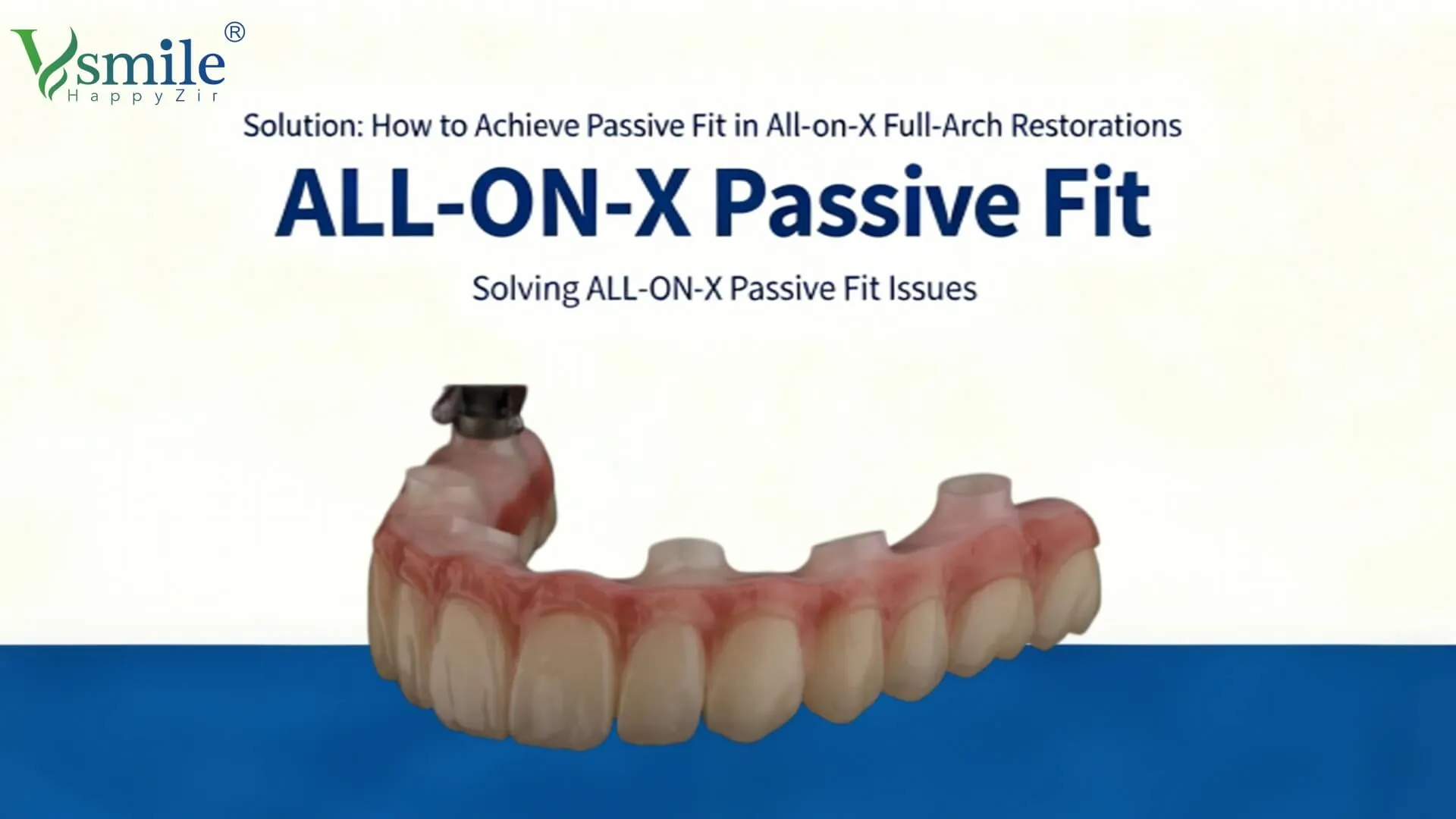
Passive fit failure is rarely caused by a single factor. Instead, it is the result of error stacking across the entire digital and manufacturing workflow.
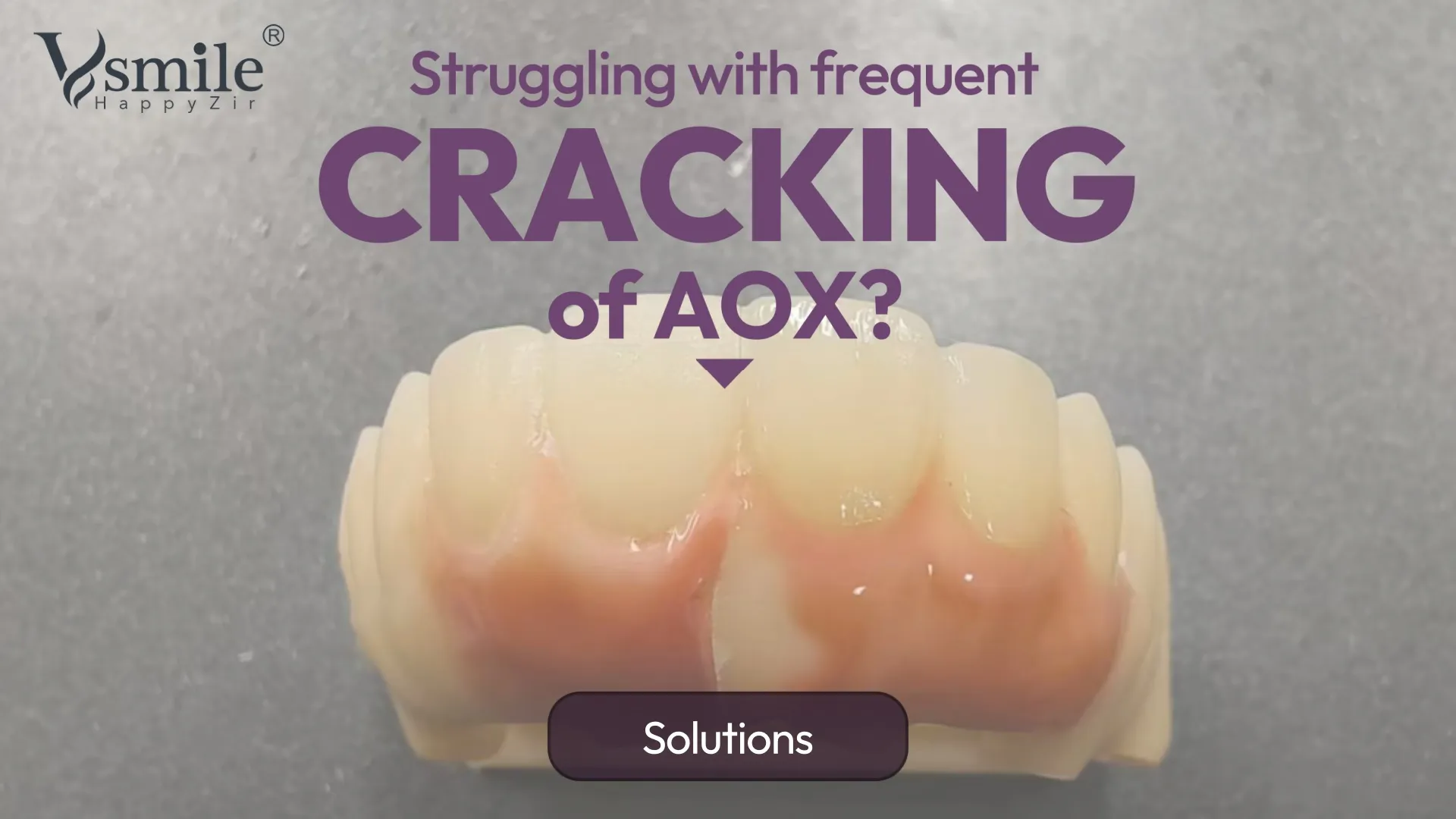
Fracture and microcracks are among the most critical failure modes in All-on-X (AOX) zirconia restorations.
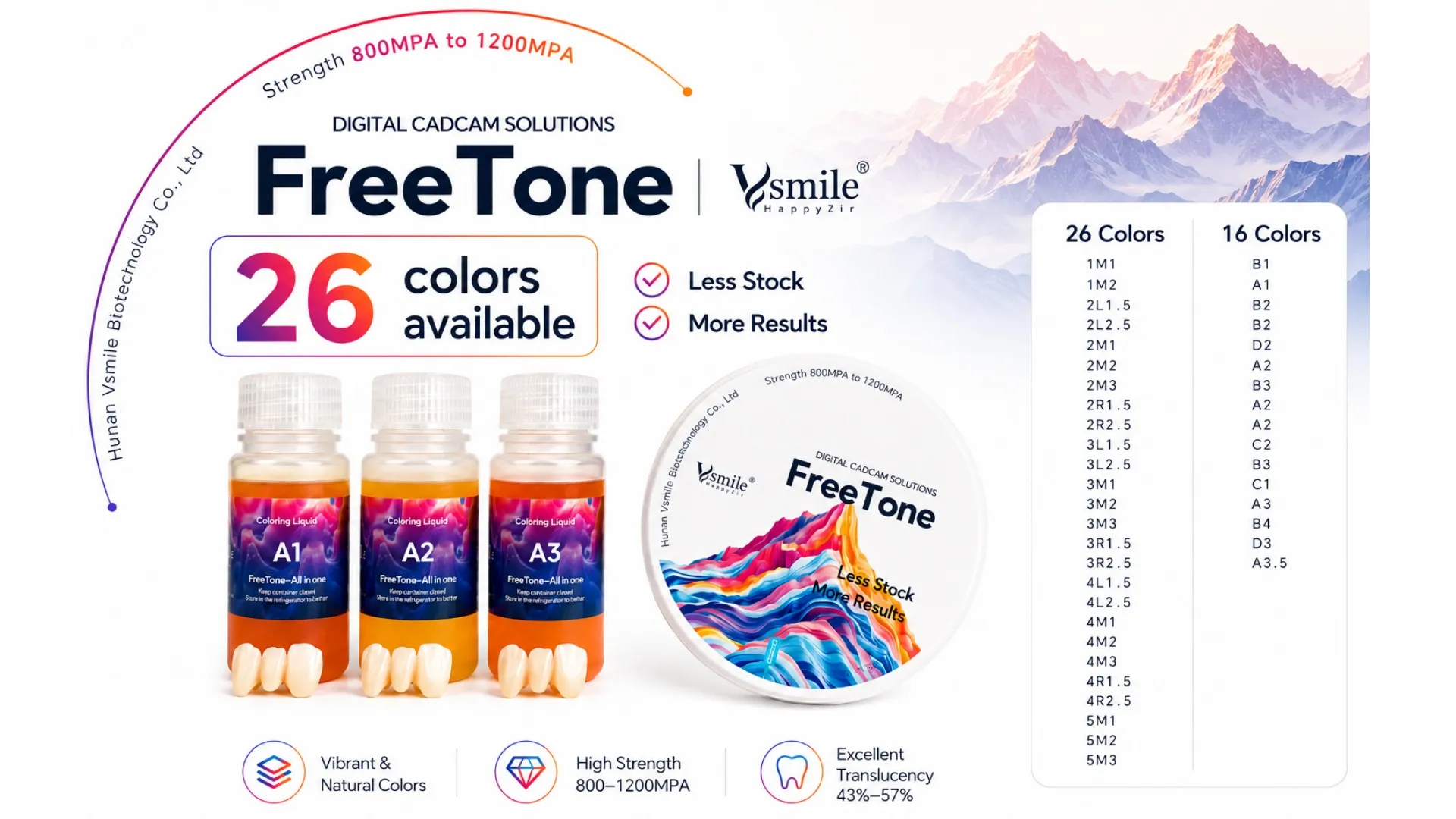
Whether you're crafting A1 or D4, FreeTone White Zirconia Disc gives you total shade control with just one SKU — streamlining inventory and increasing productivity.

Voices from Vsmile Global Partners — Stories of Trust, Growth, and Smiles We Create Together.
Long-span and full-arch restorations represent some of the most complex and failure-prone procedures in digital dentistry. Challenges include connector fractures, marginal misfits, sintering deformation, and low clinical longevity. Labs and clinics face a high rate of remakes, increased cost, and pressure to maintain quality under tight delivery deadlines.
2025.5.22

Vsmile offers a complete, validated digital workflow — from scanning to final zirconia bridge — that helps labs and clinics deliver life-changing smiles faster, with greater confidence and repeatable quality.


Tel: +86-731-85682958
Fax: +86-731-85682958
WhatsApp: +8615084896166/+8618569525651
Email: [email protected]
Address:
Room 1202-1203, Building A4,Huanchuang Corporate Park,No.2450, Yuelu West Avenue, Changsha Hi-tech Development District, Changsha, China.




























 EN
 fr
 ru
 nl
 uk
 fil
 lo
 ko
 it
 es
 el
 pt
 de
 th
 be
 sq
 tr
 ar
 vi
 pl